Latest Posts

Showing posts with label NASA. Show all posts

You know the problem with only updating every Sunday? Sometimes you're a bit late to the party for some seriously cool scientific news. 

Everyone with a curious bone in their body and an eye for space has been excited for the ground breaking news announced by NASA this week: that they may finally have evidence that liquid water flows on Mars...TODAY.
Not millions of years ago. Not even thousands of years ago. But now. It's briny stuff, but it's there. (Probably.)
Seriously, go read. I'll wait.
Done? Well I hope you've prepared yourself for a virtual hi-five, because we're both in a pretty cool time to be alive, eh?

One person who was definitely punching the air in joy this week was Ridley Scott's PR guy, because NASA's announcement couldn't have been better timed for the release date of his most recent film, The Martian.


The Martian is the story of a team of astronauts who are midway through their mission to Mars when, during a horrific storm on the Red Plant, they are forced to abandon the mission. During the chaotic flee back to the rocket their resident botanist, Mark Watney, is struck by debris and presumed dead. The crew make the difficult call to blast off for home, leaving Watney - who survived - behind to wake up alone.
The film is propelled forwards by Watney's isolated attempts to survive, as any return mission is likely to take years to arrive, assuming that NASA even find out that he's alive. Meanwhile NASA, who soon realise their horrific mistake, are left to measure out the worth of one person's life against their own reputations in a PR nightmare, tremendous expense and the risk to the lives of others that any rescue mission would mean. All of this is set to the ticking clock of starvation on the barren, vast world that Watney now inhabits.

Now there's no getting away from it, ladies and gentlemen, The Martian is basically Castaway in space and Matt Damon is Tom Hanks without the volleyball.


But just because we've seen this premise before (heck, we've even seen a similar premise before in space with Gravity), it doesn't mean that The Martian doesn't have something great to offer.


The first thing to mention about The Martian is that it looks gorgeous. I was lucky enough to see it in 3D on Wednesday and it is one of the few movies which feel like it was designed for 3D, as opposed to being scrapbooked together post-production and ending up looking like one of those victorian paper theatres. The opening shots of Mars' mountains are beautifully knitted together to give you a feeling of distance and depth which really helps the audience experience the wonder and threat of such an alien space. The 3D again takes a starring role in the smaller sets of the life-pods and space ships, allowing the layers to create a certain intimacy and realism. When you settle in you don't really notice the 3D any more, but you feel it. It lends a subtle authenticity that really works in this sort of movie. While this is - of course - a science fiction, the way the imagery is handled as well as realistic characters, skilled costuming and set design joined with a tight attention to scientific detail, means that you really can believe that this scenario is possible in our near future.


In tone, The Martian is an uplifting experience (especially for anyone with a curious mind) and is summed up best in Watney's declaration on survival that he is going to "Science the shit out of this!".  Overall it's an incredibly optimistic film, even in it's darkest moments. It would be too easy for Watney to want to roll over and die under the pressure of such odds - and our very first scene of his isolation where he attempts to tend to his injuries certainly make that clear - but in the end he finds the determination to live and the humor to keep his sanity. The film is a funny one that holds a humor made possible by the great acting all round, especially by Matt Damon, but the most uplifting part is his reliance on his own skills as a botanist and scientist to give him the ingenuity to survive and - briefly - to even thrive. Science hums throughout the whole film and is fascinating to learn about and, when we have our scenes on Earth this is brought fully to the forefront. 

In his review of The Martian Chris Stuckmann mentions that the chunks of time spent on Earth with NASA are perhaps the weakest points of the film, but I have to disagree. While I was always very eager to get back on Mars and check how Watney was doing, I thought that NASA's involvement brought a lot of reality and tension to the film that would have been lacking otherwise. One of the biggest themes for me in the film was the juxtapositions of isolation and community and how they interacted together, and NASA was one hell of a community, each with it's individual squabbles and pressures. The mix of the science, economy and politics of NASA were interesting to watch and the film would have been much less without this. By having this cast of characters at NASA arguing and pulling long nights, the stakes were raised that much higher. When they celebrated success it pushed a surge of well-wishing for Watney and anxiety in the hope that that effort wouldn't be wasted by circumstance on Mars. When NASA mourned failure it felt like a punch to the gut. Watching characters come together, and the sub plot of Watney's old crew and their involvement with his fate, added extra layers that knitted the story together very well.


So, how does The Martian stand up to its rivals Castway and Gravity?

I love both these films and I'm a fan of the lead actors in each, so it's difficult to compare them. I think, in terms of science, The Martian definitely takes the crown from Gravity. While Gravity is visually stunning, in The Martian you get far more a sense of what is at stake in space travel as well as what is involved. The science hums in the background as something quite complex but also fundamentally understandable and it is handled with such ambition and humor that it's a joy to watch. When it comes to acting and character development, I don't think you'll ever easily top Tom Hank's fantastic and emotive performance in Castaway, but Matt Damon does a very respectable job and his character - with his humor and intelligence - is certainly fun to watch and easy to root for. Plus The Martian creates far more of a community of characters on film (both on Earth and in Space), whereas Castaway is a very isolated experience.

On the whole, I really enjoyed The Martian and it works brilliantly as a film that focuses on science-fact without being unapproachable. If you're a fan of space travel then you definately need to check this out.


More Posts on Space:

-What happens to the human body when exposed to space?
-The 10 most fascinating things ever found in space
-The race to Europa
-[Guest Post] Project Orion and the atomic age
-Will we ever see a supernova up close?
-The wonders of snottites and the search for alien life


Space is Pretty Damn Awesome.

I'm no scientist, but I don't think I'm alone in being fascinated by outer space ever since I was a child. This week I wanted to nudge you towards a brilliant video that I found by Matthew Sontoro who will take us through the 10 most fascinating things that were ever found in space. I hope that you enjoy!


In Other News, I'm Moving House!

It's my first big move after university so of course it's quite emotional and quite hectic and as a result the blog will be put on the back-burner a little while it's all sorted out. Hopefully I should be all settled in with the internet working within a couple of weeks, but I wanted to let you guys know that there will be a semi hiatus. I'll try to keep putting up cool content like Matthew's video every Sunday until I get myself into gear, but don't expect any fully-fledged articles for a while.

As ever thank you for your support and your views and feel free to comment - I'm always at the end of an email ;)


Europa's surface

Europa is a pretty exciting place.

The smoothest known object in the solar system, it isn't only famous for its good looks. It's the sixth closest moon to the gas giant Jupiter, and has what is assumed to be a nickel core and an atmosphere that, while fragile, holds oxygen. It is famous for being discovered by Galileo in 1610, but  has not - as yet- been explored in any great detail by spacecraft. That, it seems is all about to change as both NASA and the ESA are primed in a race to reach the enigmatic moon.


Europa's tie to the host planet Jupiter is emphasized in her name.

While Jupiter is named after the king of the Roman Gods (aka Zeus in Greek mythology), Europa is named after one of his conquests.
For anyone familiar with Greek mythology, it's well known that Zeus was a randy deity and his wife Hera was less than impressed with his affairs. When Zeus happened upon Europa and her companions he was transfixed with her beauty and transformed himself into a white bull that was so stunning and gentle in appearance that all the women gathered around to fawn over the creature. He laid down in front of Europa and she climbed onto his back. Suddenly the bull jumped up and charged off a cliff, diving into the water below to swim out to sea with her trapped on his back. Zeus took her to Crete and  promised her that she would bear famous sons who could claim that they had a god for a father.

The real life moon mirrors its namesake in many ways. It is one that is very closely tied to water: it is believed that the crust is ice but, due to the position and shifting gravity of being so close to Jupiter, that under the surface there is liquid water. And, just as Europa begot famous sons, so too do many scientists believe that of all the places in our solar system, Europa is the one that is the most likely to birth life. Across its smooth surface, in the ice cracks, there are mysterious blooms of crimson - could these be related to the excretions of huge numbers of micro-organisms in the sea below?


The Race to Europa

Unfortunately we're not quite at the stage where any spacecraft can land on the planet due to technological limitations, and even staying in orbit with the planet for too long is dangerous for the machinery due to Europa's intense radiation fields. But nevertheless NASA and the ESA (European Space Agency) have both put forward missions and been granted funding that will allow them to launch in the mid-2020s. The ESA is currently pulling forward in the lead with the more solid date of 2022 for launch with their spacecraft 'JUICE', to reach Jupiter in 2030.


Artists impression of JUICE: ESA/AOES
JUICE stands for the 'Jupiter Icy Moons Explorer' which, if we're honest, in the world of acronyms is a bit of a cheat. Nevertheless it's plan is impressive: it is planned to set out to Jupiter to study the gas giant and, upon reaching the neighbouring Ganymede enter into humanity's very first orbit with an icy moon(!). The spacecraft will also make flybys of Callisto and Europa using various camera, spectrometers, a radar, altimeter and plasma sensors to monitor the composition of each moon and planet that it comes across, with radiation shielding to protect it and solar panels to power it on its journey.
Jupiter's moons cover a huge range of environments from volcanic to icy to rocky, so it is thought that the data gathered here could give us vital information about how similar planets in our solar system and beyond operate. Most importantly in this mission, it will give vital insights into the composition and behaviour of Jupiter - one of the largest and most alien of planets in our solar system.


Artists Impression of Europa Clipper

NASA's 'Europa Clipper' is perhaps more fully focused on the moon itself than its ESA counterpart. The plan is to place it in orbit of Jupiter and set it on a long looping orbit that would allow it to enact  45 repeated close-quarter flybys of Europa. On board there are plans for a radar to penetrate down into the crust to measure its thickness, an infra-red spectrometer to investigate what the surface is made of and an ion and neutral mass spectrometer to analyse the moon's atmosphere.


Clearly we have a whole lot to look forward to...


Sources


Supernova are probably one of the most frightening and wondrous cosmological events in our universe.


SN185
When very very dense compact stars or very very massive stars such as blue giants reach the end of their life-spans, they tend to go out with a bang.
A supernova is a massive cosmic explosion caused by a spike in the nucelar fusion of a star, or a gravitational collapse at the star's core. When this happens a massively luminious burst of radiation erupts out with many times the energy that the star will have ever created in it's lifetime. This explosion is blindingly bright (momentarily brighter even than whole galaxies) and the resultant shockwaves can destroy planets around it or even trigger the creation of new stars. When the supernova burns away often it will fizzle into a very dense neutron star or, in some cases with huge stars, it could even become a black hole.


Supernova aren't in themselves especially rare even if they are unpredictable. It is thought that they occur around three times every century in the Milky Way . But as humans we have been on this planet for a relatively short amount of time, and only for a tiny fraction of that have we been able to observe space in detail. What's more, the stars are ancient and our lifespans are modest to say the least. Have we, as a species, ever seen a supernova before and, if so, what did it look like?

Looking back through recorded history, it seems that our ancestors experienced several supernova unscathed.


185 AD - Supernova or Comet?

SN185
In 185AD Britain was governed by the Roman empire. Three years earlier Britain had been gripped by war along Hadrian's wall, following on from the earlier suppression of the 'Northen English' and 'Southern Scottish' native tribes, and its people -native and foreign - were building up their defences.For our earliest observations of supernova, however, we turn to China. 

In 185AD a whole new star was discovered. This bright point of light did not move so it was reasoned that they could not be a comet, though scientists and historians still debate over this (see Chin & Yuang). Mysteriously, the 'star' remained for 8 months it the sky before disappearing completely. Fascinated by the 'guest star', it was recorded in the Book of the Later Han which told the history of China from 25 to 220 ad.

In 2006 scientists looked into the old sources and searched the sky for evidence of the Han dynasty supernova and discovered that it had been located some 8,000 light-years away. By using the Chandra X-Ray Observatory they sound that the supernova remnant RCW 86 had been part of SN 185 and calculated that the star had exploded some 2,000 years ago.


386 AD - The Thai Ho Reign Supernova

In 386 AD Britain was still under Roman control and 'Barbarian' war and invasion from Scotland and Germany was common and violent. In 383 AD Magnus Maximus, probably a governor of Britain, was proclaimed an emperor by his troops. He campained in Gaul and defeated Gratian of Gaul, Britain and Spain, and then drove out emperor Valentinian II from Rome in order to secure his own position in the western empire. He held power for five more years before being usurped himself.

In 386 AD in China, another remarkable cosmological event flashed into the sky to last for only a few months. This could only be described as a supernova or, as was more commonly called at the time, a 'guest star'.
Image courtesy of NRAO/AUI
 
In the third month, in the spring of the 11th year of Thai Ho reign period of Chin dynasty (24th March – 22nd April 369AD), a guest star was seen in the Western Wall of the Purple Palace (Tzu Kung Hsi Yuan, or the intersection of Draco, Ursa Major and Lynx). In the 7th month, it disappeared (19th October – 17th September 369AD).”
Chin Sui, Thung Chi, Wen Hsien, Thung Khao (China)

In modern times X-ray imaging shows the supernova in all its glory. The supernova is distinctive in its green central bubble, which glows this colour due to its being created by a powerful ring being created by the pulsar 'star' at the centre of its shell. The pulsar spins remarkably fast on our terms, though it is slow for a pulsar, at 15 times per second, firing off charged electrons as it goes which scientists can then record. This supernova would have been created by a cataclysmic collapse of the massive star's core into the dense and diminutive neutron star


393 AD - The Tai-Yuan Reign Supernova

In 393 AD in Britain the Roman Empire on the island was gradually sliding towards it's final days. It would end in 409 when Britain would throw off their allegiance to Roman administrators. The Roman military had been dwindling in Britain for some time, being drawn away to help fight the troubles in Italy and when in 410 Britain appealed to Rome for soldiers and aid and were refused, the Roman empire in Britain came to  an official end.

SN393
China, it seems, has it's fair share of 'guest stars' throughout it's history, and as the civilisation were advanced enough to observe in detail these cosmological happen-stances they never passed by unnoticed. This particular anomaly happened in the lower half of Scorpio. In 393AD yet another supernova appeared for several months, only to mysteriously disappear again into nothingness.

A guest star appeared within the asterism Wěi during the second lunar month of the 18th year of the Tai-Yuan reign period, and disappeared during the ninth lunar month.


1006 AD - A Worldwide Phenomenon

SN1006
In Britain it would be 60 years before the Norman conquest, and Britain was still beset by Nord invaders. In 991 Byrhtnoth, the chief magistrate of Essex, had died fighting the Vikings and in 1013 the Danish prince Swein Forkbeard forces King Aethelred 'The Unready' into exile, following his invasion.


A mix of the location on SN1006 and the simple fact that more civilisations had caught up with China in creating consistent textual records of their history, means that we have far more sources to turn to when identifying out next supernova. The 1006 AD supernova was spotted and mentioned in China, Japan, Korea, the Arab lands, America and in Europe.


-On the I-ssu Day of the 3rd month, the 3rd year of the Chhin Te reign of the Sung dynasty (3rd April 1006AD), a guest star appeared in the southeast Sung Shu (China) 

-In Japan during the Kan Ko period, after the Kuei Yu night of the 2nd day of the 4th month of the 3rd year (1st May 1006AD), a big guest star appeared in the Chhi Kwan (Îş star of Lupus) - ‘Record of the Bright Moon’ (Japan)

 -“The sun on that day was 15 degrees in Taurus and the spectacle in the 15th degree of Scorpio. This spectacle was a large circular body, two and a half to three times as large as Venus. The sky was shining because of its light. The intensity of its light was a little more than a quarter of that of moonlight. It remained where it was and it moved daily with its zodiacal sign until the sun was in sextile with it in Virgo, when it disappeared at once.” - Ali ibn Ridwan (Cairo) 

-In pre-colonial North America a carving (see below) on a rock by Hohokam native Americans is thought to depict an important cosmological event and has been suggested as tying into the other 1006AD accounts across the globe. The carving was found in what is not the White Tanks Regional Park just outside Pheonix. The dates are likely to tie up: the Hohokam people occupied the area from between ~500 to 1100AD.
 
Petroglyph possibly depicting the supernova of A.D. 1006 (star symbol, right of center) and the constellation Scorpius (scorpion symbol, left of center). The boulder on which the petroglyphs appear is located in White Tanks Regional Park, Phoenix, AZ.
Credit: John Barentine, Apache Point Observatory
-The most northerly sighting recorded was in Switzerland. The Monks at the Abbey of Saint Gall reported of the new and strange light in the sky: "[i]n a wonderful manner this was sometimes contracted, sometimes diffused, and moreover sometimes extinguished....It was seen likewise for three months in the inmost limits of the south, beyond all the constellations which are seen in the sky"


As the Cairo source shows it is likely that the 1066 AD supernova was the brightest star ever seen with the naked eye. Other sources even reported that it was bright enough to cast shadows. The supernova, while still brief like the others previously recorded, seemed to have two main stages. At first there was a three month period where it was at it's brightest, then the light diminished, only to return for a period of around 18 months.

In 1965 the remnant left behind by this supernova was discovered by Doug Milne and Frank Gardiner, and after much investigation it has been posited that SN1006 came about through the merging of two white dwarf stars. Gamma rays affected the Earth - as often happens with supernova that are less than 100 light-years away from us - which affected the Earth's ozone layer. While from the accounts it doesn't seem that SN 1006 has any adverse affects to weather or wildlife because of this, we can still find nitrate deposits in the Antarctic ice that show what a disruption the explosion caused to Earth on a chemical level.


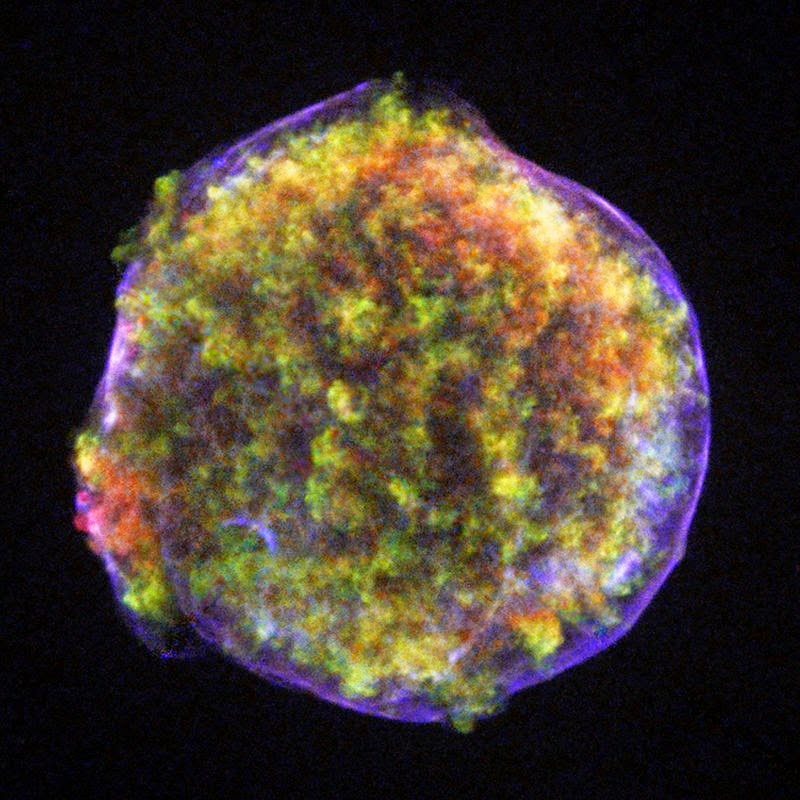
1572 AD - Tycho's Supernova

1881 illustration of Tycho's supernova
In 1572AD, Britain was rule by Queen Elizabeth 1st. On the 21st January 1571 Queen Elizabeth opened up the royal exchange, making sure to associate the crown with the prosperity of London. In 1580 Sir Francis Drake would arrive in Plymoth after circumnavigating the world, with 53 surviving crew members. It was reported that the Queen's cut of his cargo equalled in value the crown's annual expenditure for a whole year.

 With the Renaissance and its increasing circumnavigation of the globe, Europe finally turned an eye to the sky with serious curiosity and it is with the Supernova of 1572 that we get some of our strongest European sources. Europe, China and Japan all reported this remarkable phenomenon, but perhaps the most widely used source for the supernova is the Danish nobleman Tycho Brahe's book ‘De nova et nullius aevi memoria prius visa stella, iam pridem anno Ă  nato Christo 1572, mense Novembri primum conspecta, contemplatio mathematica’ (‘Concerning the New Star, never before seen in the life or memory of anyone…’).
 The new star appeared in the constellation Cassiopeia and Tycho was able to take careful measurements of the new star's position, recording it at leangth and creating accompanying drawings that survive to this day.


Tycho's Illustration of the 'New Star'

 It is thought that the appearance of this supernova, and all the recordings and discussions that it sparked, helped speed forwards the development of astonomy as we know it. The models of the heavens were revised and Aristotle's theory of the unchangeable heavens challenged, more precise astronomical devices were sought out, and the value of proper measurements was emphasised anew when creating star charts.

The supernova did not even escape Queen Elizabeth I's notice. She called her astrologer Thomas Allen and said that she would wish "to have his advice about the new Star that appeared in the Cassiopeia to which he gave his Judgement very learnedly".
SN1572
 It's not surprising that the star did not escape her notice. Reliable contemporary reports state that the 'star' flashed into creation around November 2nd/6th where it rivalled Venus in brightness. It stayed longer than the previous supernova that we've seen, remaining visible to the naked eye until 1574, where-after it gradually diminished and disappeared.

The Chandra X-Ray observatory satellite has, in modern times, managed to locate SN1572. It's an expanding bubble of plasma with temperatures in the millions of degrees and certainly had a remarkable birth.


1604 AD - Kepler's Supernova

Kepler's Drawing showing the
location of the new star at the foot(4x8)
In 1604 in Britain, King James 1st had been on the throne for a year and his first major act of foreign policy was to end the war with Spain which had been going on for some 20 years by this point, albeit intermittently. England, which had been near bankruptcy for some time at this point, was able to finally recoup its losses and peace between the two countries would continue for another 50 years.

Attached to the constellation Ophiuchus, like it's predecessor Keplar's Supernova was reported to have been brighter at it's peak than any other star in the night sky, rivalling Venus in it's magnitude. It was visible in daylight for three weeks, but was observed and tracked in the night sky for 18 months.
While named in Europe, it was also observed in China and Korea

SN1604
It is thought that the supernova occured some 20,000 light years away from Earth and it has largely been marked as the last supernova to be observed in the Milky Way, though it is debatable whether there have been other astronomical occurrences of supernovas in 1680 and 1870 that sent out signals but that generally escaped notice. It's likely that interstellar dust absorbed their light, preventing us from viewing and recording them.

 In 1885, outside the Milky Way, S Andromedae was observed and in 1987 a Andromedae-based 'Large Maellanic Cloud' was seen by the naked eye, despite its source being some 163,000 light-years away. But our Milky way seems, for now, to have fallen relatively quiet.


Could we experience supernova in our lifetime?

All of this proves just how common supernova can be, and the more advanced we become in observing the beautiful and potentially deadly universe around us, the more we can predict events like supernovae and get ready to view them in all their glory. 
The place to watch at the moment is none other than Betleguese.

No, not that one.
 
The Betleguese that Ford Prefect comes from.

Scientists have been observing Betleguese  for some time and have identified that it is remarkably unstable due to the star running out of it's core fuel. As Betleguese sits within the constellation of Orion's belt, only 640 light-years away, we are in a prime position to view the inevitable supernova in all its wonder. Despite some mild panic in 2012 when sensationalists tied Betleguese's supernova to the Mayan 'doomsday' calendar predicting the end of the world, the supernova is actually comfortably far away enough for it to cause Earth no real harm. Instead, as with our historical supernova, we would experience a bright light in the sky for a few weeks which would dim either quickly or over a year or two, before fading out completely.

So when will this happen?

While we can point out unstable stars and the inevitably of a supernova happening eventually, stars operate an wholly different time-scales to what we are used to. Betleguese will explode very soon indeed in the terms of stars, but in reality this could be anything from tomorrow to a million years from now. All we know is that it will be quite the show when it happens.


While Supernova are very dramatic, our stars are changing all the time in different ways.

IF you're curious and you have a little time to fill, the app SpaceTime tracks how our constellations have drifted and changed shape throughout history, and how they might well be next to unrecognisable in the future.


Sources