Latest Posts

Showing posts with label fashion. Show all posts


.When you live in the arctic, you know not to let anything go to waste.


The curious gut skin parka is a perfect example of this philosophy being made, as the name suggests, out of the cleaned guts of seals, walruses or whales. Surprisingly delicate in appearance despite their practical purpose; they are partially see-through and designed to be worn on top of other clothing. They could also be attached to the hatch of a kyack, which serves as a great waterproof protection for travelling arctic waters.

When european sailors travelled up and met the inuit people, they were amazed by the coats as they found that they were superior to the western oilskins in that they were more water resistant, trapped in more heat and were far lighter. The coats were highly prized and often bought for use by the western visitors.

Despite their rudimentary material, the preparation of a gutskin coat is labour intensive and complex, with the full process of creating a coat taking up to a month. The intestines are retrieved,washed and peeled inside out to be scraped. Once cleaned, they are inflated and tied at each end until completely dry, with any holes being patched. After around two days the intestines are cut and rolled into tight bundles ready for use, and the parka itself can be put together.


A lot can change in almost 1,000 years, but there is always a comforting familiarity about the lives of people throughout history.

 A photographic survey of military uniforms throughout history brings this to light by using the trendy fashion-blogger presentation of laying it all out neatly for us. In doing so the clothes take on their own aesthetic that we seldom appreciate when we see these pieces in museums.
As time goes on and warfare changes the kit grows along with the growing complexity of more and more modern technology.

I've never been a huge military history fan, but for me this is an emotive set of pictures. By laying everything out ready for dressing you can feel the presence of the man behind the clothes taking stock of his life.


Make sure to check out the Daily Telegraph article for detailed descriptions of each item in the kit. For more detailed descriptions of the individual soliders of each period, check out the photographer Thom Atkinson's comments in the 'Inventories of war' article.


Sources:
-Pinterest (via 9gag)
- The Daily Telegraph full article
-'Inventories of War'
-Photos by Thom Atkinson

Apparently originality just isn't original any more.

Throughout it's history the fashion world has always been complex. While I have a passing interest in it it would be wrong of me to act as if I know what is going on in that sphere of culture most of the time. All the same, I can't help but notice how each season brings the inevitable circuit of trends: from punky to pastels to navy to neutrals to florals back to pastels again and on and on and on. The mad couture fashion trends find their more mellow counterparts which are in turn copy-pasted as cheaper versions for high street stores. Random gimmicks break away to plaster every teenager within a thirty foot radius; older twenty-somethings do what they can to 'ironically' avoid the trend while embracing it's fundamentals; the thrity-somethings ponder over how high waisted and trim-legged jeans are supposed to be nowadays without looking cheap; and the rest of the spectrum fret about how far they can pull off new trends without looking too immature.

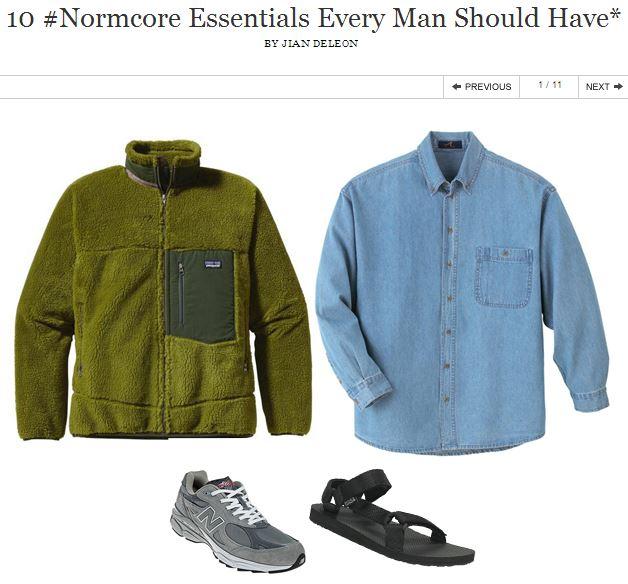
The newest trend seems to be an active attempt to separate itself from the attention-seeking fashion world, and it's called Normcore.

Behold! A new fashion trend coming near you.

"Everyone’s so unique that it’s not unique anymore. Especially in New York."
 Kristine Guico, a 26 year old 'Normcore' fashion designer explained,
"I tend to go for nostalgic things, and I feel like that’s kind of where normcore is... I was an only child. I was very into Limited 2 and Nike and basically I’m kind of still the same, fashion-wise.'

On October 19th the trend forecasting group K-Hole proposed a new trend that was developing which promoted functional comfortable fashion, focusing on blending in and sameness over individuality. Initially humorous, it now looks to have the potential to be a fully fledged trend.

'Once upon a time people were born into communities and had to find their individuality. Today people are born as individuals and have to find their communities.'

Normcore Fashion

Normcore is a somewhat natural progression from hipster fashion. Hipster fashion's aim was to be anti-fashion: to 'ironically' wear what their grandmothers and grandfather's wore. Thrift stores and charity shops were raided and the prices marked up to 'vintage' stores. People bought ill-fitting  jumpers  in bright 80s and 60s patterns which would have been painfully unfashionable mainly years ago. Girls poofed up their hair in beehives and men sculpted their facial hair into lumberjack-come-victoriana styles. The top buttons of shirts were done up - a fashion heresy before - but now a fashion statement. Through deliberately seeking out the ugly, the nostaligic or the out-dated, they mixed it with modern creativity to create something new and appealing. The results see-sawed between the ludicrous to the beautiful, but all had a rather fun statement behind them: a desire to play with what we know before.
Normcore seems to drag hipster fashion into the 90s and early noughties. I wince because I remember as an awkward early-teen wearing these abominations : the baseball caps, the double denim, the horrific tourist-fashion. While Normcore's aim is to be, well, 'normal', in doing so the fashion's wearers look maddeningly out of place - caught between fashion victims and walking figures of nostalgia.

And it's fun. It's a fond joke at the people who wear this unconciously because they have better things to worry about. It is non-fashion and yet it has all the posturing sentiment that the fashion world has.
However much normcore's goal is to 'blend in' and to be a non-movement, by being created slef-consciously, it is stand-out and a deliberate trend. Through it's popularity, like the hipster 'non-mainstream' approach, it undoes itself.  Normcore is, therefore,equal parts ludicrous and interesting as a concept, whether it's a niche joke that never rises above a meme, or whether it develops into something more real.


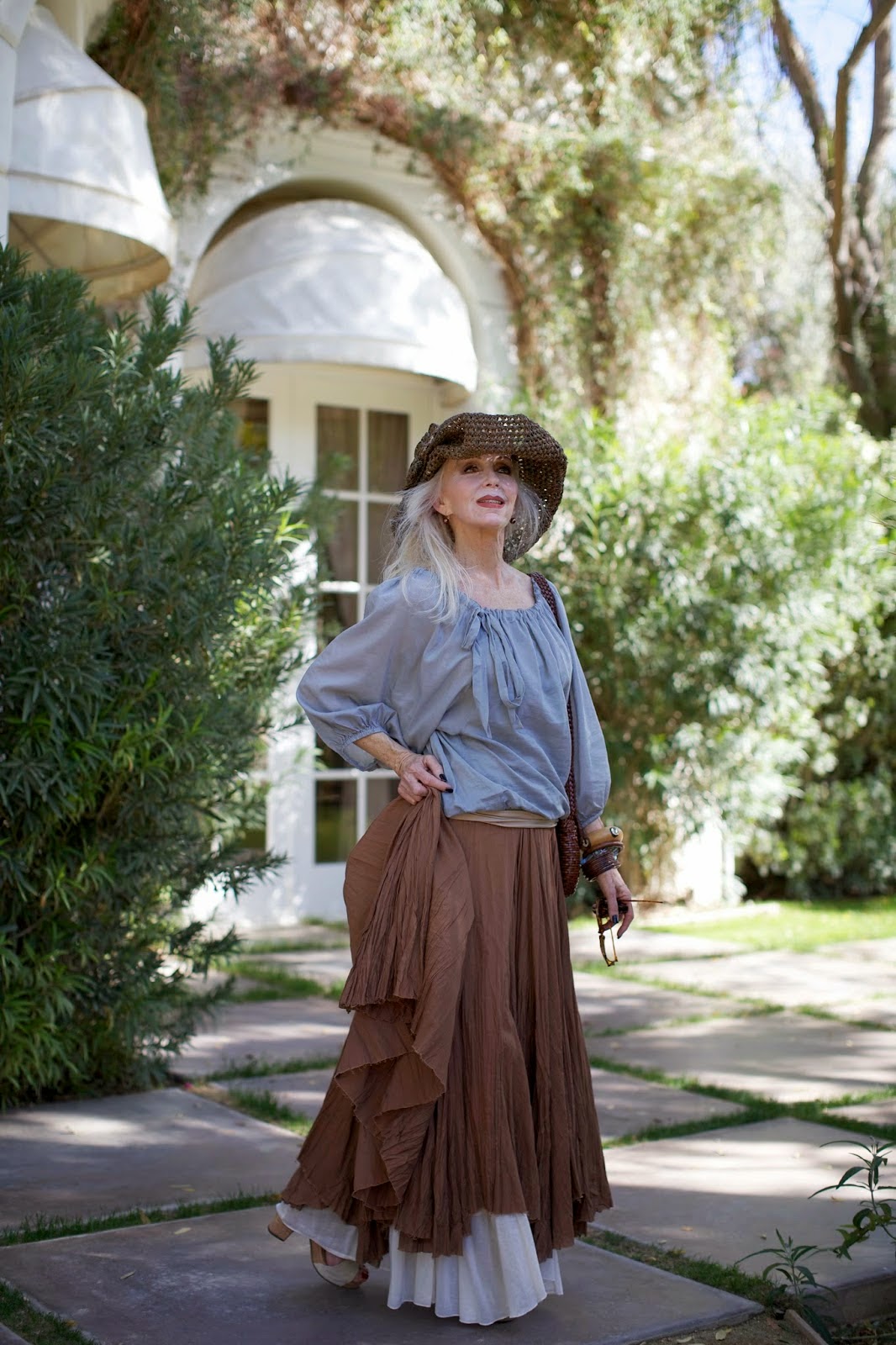
For my part, I always enjoy Street-fashion for it's creativity, and the concept of Normcore rather makes me squirm even if I kind of love its bravado. For example I have some books on two polar opposites of the street fashion world: FRUiTS [of Japan] and Advanced Style [of New York]. In urban fashion, where normal creative people are pulled off the street and photographed, you see so much of their souls shining through. There is genuine experience and joy there. 

For me, that is what fashion is. It's expressing yourself. 

 It may seem that Normcore is the antithesis of this but, in it's way, I accept that it's actually the same in many ways. It's a playful, humorous statement which reflects the wearer as much as its audience.

Still, I think I'll stick with my more eclectic preference in street fashion.
 
FRUiTS magazine is a Japanese magazine that covers the street fashion of the Harujuku district of Tokyo, and outlines where each person found their clothes and why they put them together into their creative themes.It is all about youth and bravado, to me, and playful creativity.  Advanced Style was a project by Ari Seth Cohen, where he took his camera to the streets of New York looking to chart the style and creativity of the city's older generation.
Advanced Style should, in many ways be at the opposite end of the spectrum of the typically youthful FRUiTS. But while there is dignity, experience and grace amongst Advanced Style's elders, there is also a playfulness and bravado equally as bonkers as their young Japanese counterparts. Both fashions lift your soul and remind you to live.

I, personally, think we still have the capacity to embrace the individual and find our communities. What do you think?

Check out the  'Fuck Yeah Fruits' Tumblr and 'Advanced Style' Blog for more examples.


Fruits
 
Colleen (Advanced Style)


Sue Krietzman (Advanced Style)


Sources
Normcore quote - Kristine Guico, photo by Amy Lombard

Normcore on Pintrest
Know your meme: Normcore 
FRUiTS on Wikipedia
Buy the FRUiTS Book 1 and Book 2 Here
Buy the Advanced Style Book Here


There's something very odd about punching holes in your ears.

For many girls (and, I assume, many guys) there comes a time in your childhood when you reach a crossroads. Your eyes, like a magpie's, are drawn to the shining bolts in the lobes of other children and the question that is never far from a kid's lips finds voice once again.

"Am I old enough now?!"


So far as I can remember, I wasn't allowed earrings until I started secondary school, so there was always a waiting period of impotent frustration. Magnetic and clip on earrings were pointlessly painful and they would never beat the real thing.  I wanted full blown pierced ears, like the older girls, and the whole new world of jewellery that was suddenly open to you. So, when I sat on the chair at Claire's to have two assistants stab holes in my earlobes with what effectively looked like Orwellian torture devices, I was nothing but happy and excited.

Since then I've had another three holes stabbed into my ears and filled with little gold decorations that I never take out. These are inexplicably a part of my identity now and it's always struck me as rather bizarre. 

Why did early humans, who were surrounded by disease and death at even the slightest injury, decide that boring holes in themselves was a good idea?


The history of ear piercing is certainly ancient. In 1991 the oldest mummy in the world - Otzi- was discovered in a glacia in Austria. testing showed that he was over 5,000 years old and he has his ears pierced and gauged to holes that measured 7-11mm.

Interestingly enough, Otzi the iceman also has tattoos that covered parts of his body that, archaeologists believe, were subject to wear and tear and may have caused him pain. Given the theraputic nature of his tattoos, is it possible that Otzi's ear piercings also had a benefit to his health or spirituality? 

 Ancient Persians (525-330 BC) were known to pierce their ears, and many stunning examples of earrings have been recovered, as with this example made from turquoise, carnelian and lapis lazuli.


 The depiction of a figure with an erect phallus on the above example may lead to speculation about the spiritual worth or relation to fertility that such jewellery might have. Certainly many historians and archaeologists are keen to assign spiritual reasons to these unexplained and apparently superfluous decorations. While ear piercing may have always simply been for decoration, like Otzi's piercings, it's difficult to know whether they hold greater meaning. For example, throughout history sailors pierced their ears under the belief that it might improve their eyesight. What is to say that ear piercing might not be therapeutic? Or sexually helpful? Or a protection against evil spirits? Loaded with a greater significance, it would be easy to see why our ancestors decided that an earring was worth the ever-present risk of infection.

For me, as for many women throughout history, ear piercing is as linked to coming of age as it is for fashion. In some respects it is a threshold, where one's parents acknowledge your agency and responsibility.You're no longer a rough and tumble child who is likely to pull them out and hurt themselves. You're growing up and, in a way, through allowing yourselves another form of jewellry you are adding to your arsenal for expressing your identity and -given our western standards of beauty - attracting a mate. In the end, while we may think it more subtle, there is little fundamentally different about piercing in British society than there is from, for example, the Ethiopian Mursi tribe's treatment of piercing where, upon reaching puberty, a girl is given lip and ear piercings that will be gradually gauged her whole life and assist in increasing her status.


In the end, it's difficult to know why the first man or woman decided to put themselves through the pain and risk of stabbing a hole in their ear for this decoration. But I, for one, am glad that they tried.


Naturally it doesn't begin and end with ear piercings. Throughout history and into modern times, people can pierce all manner of parts of their bodies.

Note: Some of the below examples are rather 'Not Safe for Work' (NSFW) due to graphic nudity. These have been placed as links, click them to view the examples.
 
Nose Piercings
It is thought that nose rings first appeared in India during the Monghol period of the 16th century, and excavations in India have reportedly not upturned any nose piercings before that period. In Inida, for example, traditionally the left nostril was pierced as, in Ayurvedic medicine, this was linked with femininity and the ease of childbirth.Traditionally, for for many families to the modern day, nose piercing is linked with marriage.


Tongue Piercings
 While the history of tongue piercing is in debate, it was widely believed that the Aztecs practiced tongue piercing as a form of religious blood-letting. In modern western culture it has generally been linked to provacative rebellion due to the sexual benefits it gives. Body modifications have naturally built on this, and nowadays it's possible to completely split the muscle into a 'snake/demon tongue' so that each muscle can move independently.


Lip Piercings

Like almost every piercing, lip piercings can also be gauged.  Stick in a clear plug in there and this results in something that is equal parts awesome and horrifying.
Which is exactly how it was intended.


Septum Piercing
Septum piercing is a form of nose piercing that is inserted between the nostrils, as is commonly seen in bulls.
Personally, I first saw this as the ring facing downwards in the bull style, but recently the fashion seems to be to invert it, so that the balls of the piercing peek out of the nose.  For my taste this looks a little too much like a runny nose if you catch it in the corner of your eye, but it's certainly a delicate effect.


Belly Button Piercing
Naval piercings can take up to 12 months to heal, and the risk of infection is high, but this didn't stop it being very in fashion during my secondary school years which tallies with the western 1990s and 2000s fashion trend that was seen among many pop stars. Reportedly a modern invention, it has apparently not been seen in ancient records or as widely adopted in more modern 'primitive' cultures in the same way that lip stretching and ear piercing has. Generally it is favoured by women due to the gendered differences in the fat distribution of their stomachs.


Corset Piercing
This form of piercing was designed to emulate the historical practice of wearing corsets and the pretty criss-crossed ribbons and string that were incorporated into them. The piercing itself is believed to be  a modern invention, having emerged in the mid 1990s as a form of surface piercing primarily as an erotic expression. Like all surface piercings (that is, those done on skin alone) the piercings are likely migrate and cannot heal properly as is seen in other piercings. this, added to the danger of tearing due to it's location, means that corset piercing is a temporary measure used for decoration or in BDSM play. But, due to the surface nature of these piercings, they can be worn almost anywhere on the body to impressive decorative effect.


Nipple Piercings


It's debated when nipple piercings historically 'arrived'. Some people have pointed to specific pieces of roman armor where sculpted nipple rings on the breastplate were used to attach a cape, yet there is no documentation that actually physically piercing the nipples ever happened in ancient Rome. Again in other armour there are nipple decorations seen, but unsupported by evidence that the people themselves sported them.
Also, as a side note, nipple tattoos have also become a body mod trend, and many of the results are rather lovely.
(While either option personally make me wince, I have to admit that the angel wing rings are just lovely, especially with a tattoo combination.)


                                                                                   Genital Piercings: Female

Genital piercings are reportedly believed to have been first adopted by the tribes of Southeast Asia and it is thought that they were introduced into western culture through the reports brought back from such explorations. Despite the debate that had raged in the western world throughout history about whether the clitoris actually existed or not, and indeed for a long time it's existence was even actively denied, by the 1800s the discovery of the sexual benefits of clitoral hood piercings led to their adoption. Another piercing option is labia piercing which, like the labia-stretching practiced by some as part of traditional Rwandan culture, is viewed as aesthetically pleasing and  is also adopted for sexual reasons, whether due to heightened sensation or due to BDSM or chastity-play.


Genital Piercings: Male
Male genital piercings have as long a history as their female counterparts. One of the earliest  mentions on record was the Apadravya piercing mentioned in the Kama Sutra in the second century (though this is hotly debated as possibly a myth). A similar piercing has also been traditionally adopted by the Sarawak and Sabah tribes or Boreno. The apadravya passes vertically through the glans and uretha and, while reportedly the most painful male genital piercing, is believed to have sexual benefits. Alternative piercings that serve much the same purpose are the palang, fraenulum and foreskin piercings. The foreskin piercing especially had practical purposes: for example in Ancient Greece the practice if Infibulation was common in male athletics and first mentioned in the 5th century. Here, geneital piercings were used as an anchor (a practice called kynodesmÄ“) so that the member could be pulled out of the way to one side for modesty or in order to affect the male voice. This manipulation of the genitals for practicality is said also to explain the emergence of the Prince Albert piercing. It is said that Prince Albert, Queen Victoria's husband, chose to have this piercing prior to his marriage so that his member was held to one side to avoid unsightly bulges in the tight trousers that were fashionable at the time. Called a 'dressing ring' at the time, this would then attach to a hook within the clothing. The story itself has come under debate, with some questioning whether the originator was actually Prince Albert the grandson, rather than Victoria's husband, and many questioning the practice at all. It seems that we may never know, but there is no denying it's modern popularity for entirely different reasons.
Finally, surface piercing further extends the creativity of male genital piercing, with some examples being the hafada  piercing on the scrotum and guiche piercings - the latter of which is also chosen by many women.


In the end, it seems that the variety of human piercings is only ever limited by our own imaginations. From ancient times to the modern day, they are still imbued with a fascinating arrange of meanings. Whether they work as marks of coming-of-age, as testaments of courage, badges of social rebellion, items of beauty, symbols of sexuality, or are for simply practical use, it is clear that piercings are a very important part of our culture.


Sources: