Latest Posts

Showing posts with label curio. Show all posts
 The world is doubtlessly beautiful, but sometimes beauty can be found in odd an unconventional forms.

So it is with perhaps one of the more repulsive lifeforms on our earth: the slime mould. But despite its rather unflattering name and underwhelming looks, this creature is both fascinating and have given us unique insights that will help us in our futures.


Slime Moulds
via Discover Magazine


 Eugh...

You're wandering through the woods, minding your own business. The leaves are dark and wet against your feet but hey, you thought ahead and wore wellies this time - nothing can stop you! You tilt your head up and close your eyes as you breathe in the fresh, clean, damp air. Distracted, your foot catches in the hook of a root and, before you know it, you're tripping and falling. You push out your hands out in front of you to break your fall and your palms connect with..this.
Ew.

So what are they? 

There's no surprise in where slime moulds got their names from. Slimy and toxic-yellow, they cover rotting wood and eat fungi. They have no brains or nervous system and so share the most in common with amoebas. Aside from their generally unpleasant appearance they might be entirely unremarkable, it it wasn't for the way they move and navigate the world around them.


Why are they so important?

Slime moulds navigate their way around the forest floor searching for food in a very interesting manner, which has given scientists great insight about efficiency and how we might best be able to program robots or build transport systems.
They move using pulsing tendrils called psudopods which, through a clever organization can navigate the world without a brain:


"Every part rhythmically expands and contracts, pushing around the fluid inside. If one part of the plasmodium touches something attractive, like food, it pulses more quickly and widens. If another part meets something repulsive, like light, it pulses more slowly and shrinks. By adding up all of these effects, the plasmodium flows in the best possible direction without a single conscious thought. It is the ultimate in crowdsourcing."- Ed Yong

This mimics how other creatures, such as humans and ants, navigate the world. But in this case the lack of a brain is what is remarkable. Human hikers might explore woodland and fields and, over time, trails are stomped into the ground by many trudging feet. The trails that are the most effective remain, trodden into the grass, and those that proved inefficient are difficult are used less and so gradually overgrow once again. This way the less efficient routes are gradually erased and the more efficient routes are reinforced. When ants go exploring they do something similar using pheremones. They lay out pheremones to plot their path so that they know where they've been before and this discourages other ants from trotting down pointless routes. When the ants find something they like, they pump out another pheremone which attracts other ants down that route. This way efficient routes are reinforced and many a full ant belly is had by all.
The brianless slime moulds do they same: they send out slime trails that explore routes. The inefficient paths are abandoned and lesser slime is left to significy that these routes should not be used again, whereas when an efficient and lucrative route is discovered more stronger slime mould is encouraged down it, emphasising its efficiency.

This was put to the test as scientists placed slime moulds on a map of Tokyo where they had placed food points where all the major cities were. They found that despite not knowing their environments or having any opportunity to plan, Slime moulds tracked out the most efficient routes which - amazingly - matched up with the road systems all ready put in place. By sending out trails to all possible configurations and then drawing back to leave only the most efficient, the slime moulds became city planners.
The same could be done with maps around the world.


This ability also allows the slime moulds to navigate mazes, which is an important development as it can be a lesson used to assist in the programming of robots. Because it's too complicated and uses too much memory to program robots with pre-programmed maps or for them to build up maps as they explore, one way of allowing them to move freely without getting trapped is to program in an imperative to 'avoid the past', as slime moulds do. By doing so like slime moulds sending out all their trails and then reducing them down, robots can freely explore and then naturally reduce down their movements to use only the most efficient routes.

These are only some of the large variety of experiments that are being conducted with slime moulds. These humble gooey creatures are set to teach us a heck of a lot about decision making processes, efficiency, and how best to plan for our collective futures.


Sources
-Slime mould memories: discover magazine
-'Slime mould make decisions like humans'
-'Slime mould attacks simulate Tokyo rail networks'
-BBC Youtube: Slime mould time lapse
-The Gaurdian 'Let Slime moulds do the thinking' 


And now for something completely different:

Next week I will be packing up and trotting off to Download Festival, whereby I will participate in the noble tradition of standing in a field and getting rained on for three days straight.

On a side note, did you even know that there is wellie-related porn? I certainly didn't until I did an image search, so I hope you appreciate this picture!

As a result, I won't be able to contribute next Sunday. But fear not, regular programming will resume from then on...




I'm going to begin with a confession of sorts: I am not a linguist.

I'm in the very lucky position that my native language is one that - nowadays - is popularised as a global from of communication. Of course, it wasn't always so. Back in history, the primary Eurocentric language of learning was Latin. By having a relatively common language that spread throughout Europe and even beyond, it allowed people of many different cultures and native languages to share ideas through a simple unified form of communication. As a 'dead' language, Latin was quite firmly set and widely understood. English, for the time being, seems to have taken Latin's place and it is thought that around 750 million people are thought to speak English as a foreign language. 

I've studied some languages at school and have unsuccessfully attempted to learn French, Spanish and even a little Japanese. The issue I had was one that is, I believe, shared by a lot of my native English speakers: without the necessity of using multiple languages in my everyday life the skills very quickly slip away. It's still my hope to learn (and retain) a foreign language in my future but, for the time-being, the prevalence of English as a language brings a rather curious question to mind: what does English actually sound like?

As an English speaker I always hear the languages of different countries as easily discernible accents. Within the English language itself there are also countless variations of accent: from South African to North-American to Welsh to Northern-English to West-Country English to 'R.P' English and more. But the form of how a language sounds is more than just accent. Wouldn't it be fascinating to take a step away from our comprehension of or own language and hear how we sound to other people?
As ever, Youtube answers our call with this brilliant little drama, 'Skwerl':


Using what can only be described as the language from the Sims (or Simlish) we can get an idea of the tone of how American-English sounds without the comprehension of the words.
(Also, as in my case, you can gradually drive yourself insane as you ask whether the guy actually once said 'Elton John' or whether you just imagined it.)

The Finnish Youtuber Sara took this to the next level, also comparing North-American and London-English alongside other languages like Finnish, East-Asian, French 'Not Russian but sort-of Slavish', Estonian and more.


Beauty seems to be in the ear of the beholder: for some British-English is 'fast' and 'aggressive', but for others it seems to 'flow' and have a certain music about it, which gives it a song-like appeal. For some, we don't seem to open our moths enough, making us sound like 'chickens', but for others English seems to sound 'refined'. Really, in the end, it depends on where you're from, what cultural assumptions link in with the language, and what you prefer.


Of course, English has never been a static language, and has evolved over time.
Even if we discount the way that slang and changing cultural trends affect the language today it has undergone some major changes.

As a lot of English's widespread use today is due to conquest, it is rather ironic that it's birth was the result of the country being invaded by outside forces too. Originally the inhabitants of England spoke a form of Celtic but as the country was invaded by the Germanic tribes in the 5th century ad, many native speakers were pushed West and North into what is now Wales, Ireland and Scotland.
Nowadays some of these languages still survive as the Goidelic and Brythonic branches of the Celtic language. For example, Manx is a Goidelic form of language that is still learnt on the Isle of Man, although the last truly native speaker -Brian Stowell - died in 1974. Welsh, perhaps the most well known Celtic language, belonged to the Brythonic branch and is still in common use today.


The invading tribes all had quite common languages, and these developed into the British 'Old English' which occupied the island between 450-1100ad. J.R.R Tolkien was a professor of Anglo-Saxon and his love of the Mercian language (best known in Beowulf) influenced him heavily. You can see the influence of old English in the language and writing of the Elves. Nowadays, Old English is exceedingly difficult to comprehend to native modern-English speakers, but we still carry on many of the words that grew from it, such as 'water'.


Following on from Old English was Middle English which, again, was heavily influenced by another devastating invasion as William the Conqueror claimed England in 1066. French became the language of the royal court and so was very closley tied with class and power. Anyone aspiring to favour with the ruling classes would need to learn French and English was associated with the lower classes. Between 1100 and 1500 ad Middle English developed and, as English returned to some dominance in the 14th century, we can see it in its most well known from through the works of Chaucer.

"This parish clerk, this joly Absolon
Hath in his herte swich a love-longinge,
That of no wyf ne took he noon offringe;
For curteisye, he seyde, he wolde noon
."


As you can see (and as no doubt many a student has suffered through), the language was still one that is quite different to modern English as it is spoken today.


During the end of the Middle English phase 'The Great Vowel Shift' began, where there was a sudden and distinct change in pronunciation. For example the word 'Mice' changes from the pronunciation of mees into the high-i that we know today. As writing (and later printing) in these days was largely phonetic, this caused a great difference in the way the language was recorded. It is thought that this was due to a change in prestige and the desire to reinforce a new classism of language. As French was losing its prestiege a new English form of linguistic prestige was needed to easily display one's status. Alongside this, migrations from the Midlands put people into contact with Londoners this desire for a new verbal social status perhaps helped create this significant movement in pronunciation.


Early Modern English was the language of the sources that I studied in uni and, if you look closely at them, they are quite easy for a modern English speaker to understand. The greatest challenge was to get used to the font in the early printed works (and it's habit for using Ys for 'th' sounds and Us,Vs and Ws interchangeably). Once you have that conquered I found a handy (and somewhat ridiculous) way to 'cheat' your way into comprehension. Basically read aloud....and read it in a bad cornish or west-country accent. Yes, you will look like a berk, but things will be much easier to read.


The printing revolution gradually standardised spelling and grammar and, because London was the place that contained the most printing houses, the English language slotted in to fit with this London-based language form. In 1604 the first English dictionary was published and the whole process was made scholarly and formal.

 By the 1800s English's form was largely fixed and formed a solid base for the whole flurry of  new words that came with the Industrial Revolution. As Britain's power grew alongside the technological innovations, it was the island's turn to become the invading linguistic force and the language spread quickly with the British Empire. Now the empire has faded away and America has become one of the great cultural powers of the world. the influence of the language is following suit and evolving English into even more forms into the future.

So, in short, English is a pretty fascinating language from either perspective: as a native or as a non-native speaker.
What is your experience with it? Have you seen the language evolve audibly over time? 
Are you a non-native speaker and, if so, what does English sound like to you?
Have you had to suffer through any 'Ye Olde English' languages?


To finish things off, I leave you with Lily Allen's 'Smile' in Simlish, because you need Sim music videos in your life :)


Sources

-The Metro: How English sounds to foreign ears
-The British Council Statistics of English Language Users
-Why Speaking English Can Make You Poor When You Retire (BBC)
-Huffington Post
-Internet slang added to the Dictionary
-History of the English Language
-Celtic language by digital medievalist.net
-Tolkien and Old English
-The Great Vowel Shift

The Sun is a magnificent thing.

It is 109.2 time's larger than our humble Earth, with a radius of 695,508km and a mass of 1,989,100,000,000,000,000,000 billion kg. With a surface temperature of 5,500 degrees Celsius it is a hellish landscape, often spewing out tendrils of radioactive heat and solar winds that, at any moment, has the potential to wipe us out. Yet, paradoxically, these winds are captured and warped by the Earth's magnetic fields into the heavenly spectacle of the Northern Lights. Despite the hellscape of the sun's surface, this heat gives us light and life.  Despite the distance between this vast star and our planet, we see it as a humble bright speck that grants order and wonder to the creatures that scuttle beneath it. Like clockwork the sun counts the days and, at each night, it appears to leave us.

Even in these days of modern space travel the significance, power and beauty of the sun still continues to enchant us. So it is of no surprise that, in our cultural pasts, the sun was revered and became the subject of many a creative legend in order to explain it's presence and role in our skies. This week I wanted to share just a few of the multitude of unusual stories about our sun from history, courtesy of the brilliant book Mythology: an Illustrated of World Myth and Storytelling (Edited by C.Scott Littleton).


Grandmother Spider Steals The Sun

The Native American peoples have many creation stories about the sun and the stars, with many stories focused around the animals that lived in the great continent. For the Cherokee people in the south-east, these animals brought the sun to their lands through teamwork and clever theft.

"At first there was no light anywhere and in the darkness everyone kept bumping into one another. "What we need in the world is light!" they all agreed, and so they conveyed a meeting. The red-headed woodpecker made a suggestion: "People on the other side of the world have light, so perhaps if we go over there, they will give us some."
After much argument, Possum said: "I'll go and get light. I have a bushy tail and can hide the light in my fur." So he travelled east, screwing up his eyes against the brightness. When he arrived on the other side of the world, he found the sun, grabbed a piece of it and hid it. But the sun was so hot that it burned all the fur from his tail, and when he came home he had lost the light.
Next, Buzzard went on a quest. On reaching the sun, he dived out of the sky and snatched a piece of it in his claws. Setting it on his head, he started for home, but the sun burned off his head feathers and Buzzard also lost the light. When Buzzard returned home bald, everyone despaired.
Suddenly they heard a small voice from the grass. "You have done the best a man can do, but perhaps a woman can do better." Who is that speaking?" the animals shouted. "I am your Grandmother Spider," replied the voice. "Perhaps I was put in the world to bring you light."
The Spider rolled some clay into a bowl and started towards the sun, leaving a trail of thread behind her. When she was near the sun, she was so little that she wasn't noticed. She reached out and gently took a tiny piece of the sun. Placing it in her bowl, and following the thread that she had spun, Spider returned from the east to the west. And as she travelled the sun's rays grew a spread before her, across the whole world.
To this day, spiders webs are shaped like the sun and its rays. And spiders always spin them in the morning, to remind us of their divine ancestor."


When the Sun Lived on the Earth
The San people (previously known as the 'bushmen' of the Kalahari) have lived in Africa for some 20,000 years and stories have been passed down to the modern day through a vast oral tradition. One of the tales about the sun's first appearance in the sky gives the sun a human origin.

"In the earliest days the sun lived among the tribes of the bush. he was like other men except that a brilliant light shone from his armpits when he raised his arms; then when he let his arms fall again, darkness swept across the Earth. A wise old woman instructed her grandchildren to creep up on Old Man Sun and hurl him into the sky so that the light he released could fall far and wide on all living things. they waited until the Sun had laid down on the ground to sleep, then they crept towards him stealthily and in an instant had seized him and flung him high over their heads into the great cavern of the sky. They called out to him to stay put and to descend no more to Earth. Far away, across the bush, the children's relatives saw the Sun appear as a golden sphere in the heavens and were pleased. the darkness was driven from their skies."


The Boomerang and the Sun

One of the many stories from the aborigine people of Flinders range in Australia tell the tale of how the sun came to make it's cycle across the sky after previously an eternity of daylight. It was all down to the revenge of a Goanna lizard and a gecko.

"One day the Goanna and the Gecko set out to visit neighbours only to find, to their horror, that their friends had been massacred. With one voice they declared vengeance on the one who was responsible. It had, it soon transpired, been the sun-woman and her dingo dogs who had attacked and killed the defenceless community: she was a formidable foe and the Goanna and Gecko were quite undaunted. As the sun-woman stormed and shouted her defiance, the lizard drew his boomerang and hurled it and dashed the sun clean out of the sky. She plummeted over the western horizon, plunging the world into total darkness - and now the Goanna and the gecko really were alarmed. What would become of them without the sun-woman and her warming illuminating rays? They must do everything they could to restore her to the heavens. the Goanna took another boomerang and hurled it westwards with all of his might to where he had seen the target disappearing. It fell ineffectually to the ground so he threw two others to the south and to the north, but they too drifted back without hitting anything. In despair, the Goanna took his last boomerang and launched it into the eastern sky - the opposite direction from that where he has seen the sun-woman sinking. To his astonishment it returned, driving before it the sun's burning sphere, which tracked westwards, across the sky before disappearing. From that day on the sun maintained it's course, rising in the east and setting in the west, lighting up the day for work and hunting and casting the night into shade for sleeping. All agreed that this was an ideal arrangement, and the Aborigines of the Flinders have felt a debt of gratitude to the Goanna and the Gecko ever since."


The Sacrifices of Tecuciztecatl and Nanahuatzin

The cyclic nature of the gods and creation in mesoamerican culture was one that was tainted with bloodshed and sacrifice, and it was through the sacrifice of two noble gods that the sun and the moon came into being once again.

"The creation of the sun and moon took place at the great ceremonial centre of Teotihuacan, about twenty-five miles northeast of modern Mexico City. After the fourth holocaust, in which the sun as well as the earth had been annihilated, four gods met in the darkness at Teotihuacan to create a new sun. They agreed that the self-sacrifice of a god was required to bring it into being.
As the gods discussed who should die by fire to create this new sun, the vain and handsome Tecuciztecatl put himself forward "to carry the burden, to bring the dawn." but the gods decided to make him compete with a god Nanahuatzin for the position of sun or moon. Although an equally powerful god,
Nanahuatzin was very humble, maybe because he was disfigured by running sores.
While the gods built a vast sacrifiial bonfire,
Tecuciztecatl and Nanahuatzin did penance on two mounds. the two gods now presented offerings that reflected their personalities.Where vain, boastful Tecuciztecatl brought quetzal feathers and gold, Nanahuatzin brought bunches of reeds. Where Tecucixtecatl offered awls of coral and jade, Nanahuatzin merely offered cactus spines anointed with his own blood.
When, after four days, the sacrificial fire had become searingly hot, the two gods were robed for their ordeal. Tecuciztecatl ran towards the flames but four times recoiled in terror from the intolerable heat. So the gods called on Nanahuatzin. daring, determined, resolved and with hardened heart, he shut his eyes. he did not falter or turn back. All at once he threw himself into the fire. His body crackled and sizzled and he burned. Spurred on by Nanahuatzin's heroic act, Tecuciztecatl too ran into the pyre.
The gods now waited in the darkness for the birth of the new sun. But instead Tecuciztecatl rose as the moon, casting a blinding light. To subdue his brilliance, one of the gods threw a rabbit up into his face. This rabbit can still be seen on the face of the full moon.
Nanahuatzin now rose in the heavens as the new sun, but refused to move across the sky until he had been fed with the hearts and blood of all the other deities. Incensed at thsi demand, the Morning Star attacked the sun with his darts and spear, only to be defeated and hurled down into the underworld. The sun god was acknowledged as supreme, and all 1,600 gods now allowed themselves to be sacrificed,
The humble, ulcerated Nanahuatzin was thus transformed into the mighty sun god Tonatiuh, he "who blinded one with his light". The first day of the fifth sun has begun."


For every culture that has turned its face up to the sun, there are creative stories that tell of its history. I hope that you've found some of these more uncommon stories as interesting as I have.


Sources
-Space facts
-The sun's name
-Current Solar Images
-The San People
 -Stories taken from the brilliant book Mythology: The Illustrated Anthology of World Myth and Storytelling  -general Editor C.Scott Littleton


Apparently originality just isn't original any more.

Throughout it's history the fashion world has always been complex. While I have a passing interest in it it would be wrong of me to act as if I know what is going on in that sphere of culture most of the time. All the same, I can't help but notice how each season brings the inevitable circuit of trends: from punky to pastels to navy to neutrals to florals back to pastels again and on and on and on. The mad couture fashion trends find their more mellow counterparts which are in turn copy-pasted as cheaper versions for high street stores. Random gimmicks break away to plaster every teenager within a thirty foot radius; older twenty-somethings do what they can to 'ironically' avoid the trend while embracing it's fundamentals; the thrity-somethings ponder over how high waisted and trim-legged jeans are supposed to be nowadays without looking cheap; and the rest of the spectrum fret about how far they can pull off new trends without looking too immature.

The newest trend seems to be an active attempt to separate itself from the attention-seeking fashion world, and it's called Normcore.

Behold! A new fashion trend coming near you.

"Everyone’s so unique that it’s not unique anymore. Especially in New York."
 Kristine Guico, a 26 year old 'Normcore' fashion designer explained,
"I tend to go for nostalgic things, and I feel like that’s kind of where normcore is... I was an only child. I was very into Limited 2 and Nike and basically I’m kind of still the same, fashion-wise.'

On October 19th the trend forecasting group K-Hole proposed a new trend that was developing which promoted functional comfortable fashion, focusing on blending in and sameness over individuality. Initially humorous, it now looks to have the potential to be a fully fledged trend.

'Once upon a time people were born into communities and had to find their individuality. Today people are born as individuals and have to find their communities.'

Normcore Fashion

Normcore is a somewhat natural progression from hipster fashion. Hipster fashion's aim was to be anti-fashion: to 'ironically' wear what their grandmothers and grandfather's wore. Thrift stores and charity shops were raided and the prices marked up to 'vintage' stores. People bought ill-fitting  jumpers  in bright 80s and 60s patterns which would have been painfully unfashionable mainly years ago. Girls poofed up their hair in beehives and men sculpted their facial hair into lumberjack-come-victoriana styles. The top buttons of shirts were done up - a fashion heresy before - but now a fashion statement. Through deliberately seeking out the ugly, the nostaligic or the out-dated, they mixed it with modern creativity to create something new and appealing. The results see-sawed between the ludicrous to the beautiful, but all had a rather fun statement behind them: a desire to play with what we know before.
Normcore seems to drag hipster fashion into the 90s and early noughties. I wince because I remember as an awkward early-teen wearing these abominations : the baseball caps, the double denim, the horrific tourist-fashion. While Normcore's aim is to be, well, 'normal', in doing so the fashion's wearers look maddeningly out of place - caught between fashion victims and walking figures of nostalgia.

And it's fun. It's a fond joke at the people who wear this unconciously because they have better things to worry about. It is non-fashion and yet it has all the posturing sentiment that the fashion world has.
However much normcore's goal is to 'blend in' and to be a non-movement, by being created slef-consciously, it is stand-out and a deliberate trend. Through it's popularity, like the hipster 'non-mainstream' approach, it undoes itself.  Normcore is, therefore,equal parts ludicrous and interesting as a concept, whether it's a niche joke that never rises above a meme, or whether it develops into something more real.


For my part, I always enjoy Street-fashion for it's creativity, and the concept of Normcore rather makes me squirm even if I kind of love its bravado. For example I have some books on two polar opposites of the street fashion world: FRUiTS [of Japan] and Advanced Style [of New York]. In urban fashion, where normal creative people are pulled off the street and photographed, you see so much of their souls shining through. There is genuine experience and joy there. 

For me, that is what fashion is. It's expressing yourself. 

 It may seem that Normcore is the antithesis of this but, in it's way, I accept that it's actually the same in many ways. It's a playful, humorous statement which reflects the wearer as much as its audience.

Still, I think I'll stick with my more eclectic preference in street fashion.
 
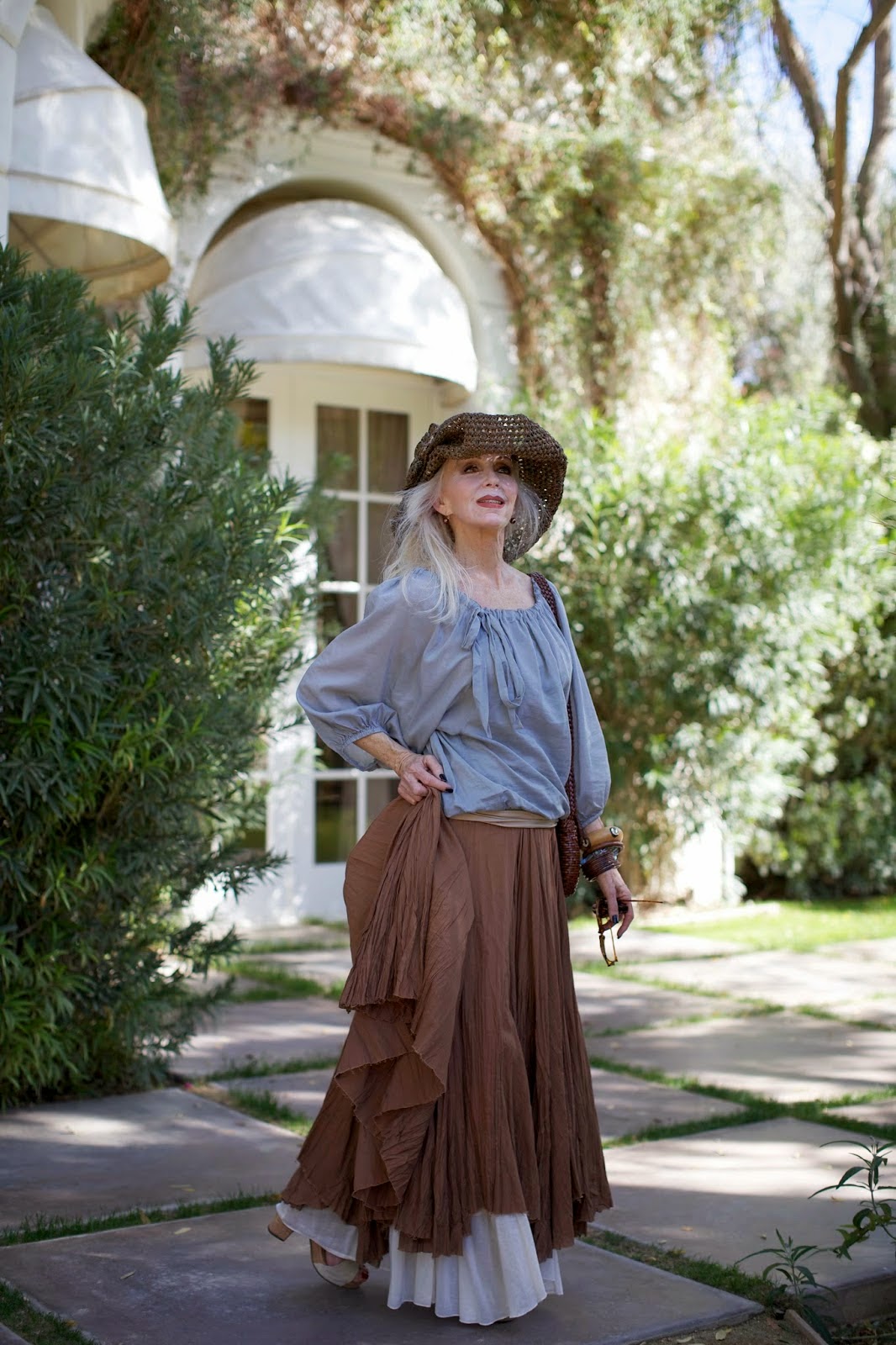
FRUiTS magazine is a Japanese magazine that covers the street fashion of the Harujuku district of Tokyo, and outlines where each person found their clothes and why they put them together into their creative themes.It is all about youth and bravado, to me, and playful creativity.  Advanced Style was a project by Ari Seth Cohen, where he took his camera to the streets of New York looking to chart the style and creativity of the city's older generation.
Advanced Style should, in many ways be at the opposite end of the spectrum of the typically youthful FRUiTS. But while there is dignity, experience and grace amongst Advanced Style's elders, there is also a playfulness and bravado equally as bonkers as their young Japanese counterparts. Both fashions lift your soul and remind you to live.

I, personally, think we still have the capacity to embrace the individual and find our communities. What do you think?

Check out the  'Fuck Yeah Fruits' Tumblr and 'Advanced Style' Blog for more examples.


Fruits
 
Colleen (Advanced Style)


Sue Krietzman (Advanced Style)


Sources
Normcore quote - Kristine Guico, photo by Amy Lombard

Normcore on Pintrest
Know your meme: Normcore 
FRUiTS on Wikipedia
Buy the FRUiTS Book 1 and Book 2 Here
Buy the Advanced Style Book Here


They always say that life will find a way to survive.


At 1.23 am on April 26th 1986 a catastrophic event took place in the wooded marshlands of Chernobyl, Ukraine, that would forever test this assumption. 

A day earlier, at 1am on April 25th, routine testing began on reactor four of the Chernobyl nuclear power plant to see whether the plant's turbines would be able to maintain the cooling of the system in the case of a power outage, until the backup generators could come into use. In order to simulate the circumstances of the power outage, the participating workers shut down many of the safety systems. However, in the middle of the test a high power demand from Kiev (80 miles away) stalled the operation, and it was not recommenced until 11.10pm that same night. After 1am on April 26th a sudden power surge caused the reactor to dangerously malfunction. Without the safety systems in place there was nothing to stop the crisis escalating and within 23 minutes the reactor itself exploded with disastrous results.

The initial death toll of the plant was put at thirty, as several plant workers and emergency rescue personnel were either killed in the blast or succumbed to injury and radiation sickness. However the true extent of the disaster was quickly placed under debate. While the direct death toll was regarded by the UN in 2005 to be as low as 56, the full extent of the effect of the nuclear poison has been under significant debate over the following decades, and the estimations are harrowing. The UN posited that the cancer figures attributed to the radioactive poisoning of Chernobyl were some 4,000, however Greenpeace claimed that some 270,000 cancer cases were attributed to the disaster, resulting in some 93,000 fatalities. This number grew exponentially in the paper 'Chernobyl: Consequences of the Catastrophe for People and the Environment was published by the New York Academy of Sciences' by Dr. Alexey Yablokov, Dr. Alexey Nesterenko,Dr.Vassili Nesterenko and Dr. Janette Sherman. Founded on a research base of some 5,000 separate reports, and making use of records which have been released from official secrecy, they assert that between 1986 and 2004 some 985,000 people died of cancer that was directly caused by the Chernobyl meltdown. The release of the radioactive poisons of Cesium-137, Plutonium, Iodine-131 and Strontium-90 were tracked to spread across the globe. It consumed the Ukraine, Bulgaria, Finland, France,Germany,Greece,Italy,Poland,Sweden and the UK, with some 10% of fallout across eastern Turkey and Central China, and with an additional 5% dropping upon Northern Africa. It is thought that the radiation from the disaster was 100 times more powerful than the atomic bombs dropped on Hiroshima and Nagasaki.


These figures are, and always will be, under furious debate. 

 Historically, the records and crisis-management of Chernobyl were tempered by the politics of the still chilly Cold War. Attempts at secrecy meant that the full extent of the disaster was not discovered until the Swedish Forsmark nuclear power plant in Stockholm registered unusually high radiation levels. When other nuclear plants across the world had similar readings they contacted the Soviet Union, who denied all knowledge about the disaster until 9pm on April 28th. 
Even now, the admission of the extent of the disastor is one that brings a very heavy political burden, and therefore it is debatable how much still remains in secrecy, and how far studies are potentially manipulated to serve these motivations. Nuclear power offers an efficient alternative to the world's fossil-fuel energy crisis, and has the potential to work with far greater power and efficiency than it's greener options. The greatest fear of Nuclear power comes in the wake of the Chernobyl disaster, and with the recent Fukushima disaster this fear has been reinforced as history is repeated. The public and policy makers must weigh up whether the scale of nuclear disaster balances with the scale of energy advantages for the future. The tenuousness of this balance will always make this a very controversial subject indeed.

The Soviets began trying to clear up the disaster in secrecy. It took nearly two weeks to put out the fires. Pipyat, the nearby town that housed the workers and their families, was evacuated on April 27th, but the rest of the population were only advised to stay indoors and were not evacuated until almost a week later. Chernobyl was sectioned off into various 'exclusion zones' which were chosen based on the measurement of radiation in those zones, and which still remain to this day. Now, over 25 years later, some of the outer zones are being declared suitable for tourism and limited settlement. The burning, burying and containment of radioactive materials began soon after the blast  and the reactor itself was contained in a concrete 'sarcophagus' which, by 1997, leaked. In 2013, the 'New Safe Confinement' sarcophagus was being built to replace the damaged container.


The New Safe Confinement construction, filmed by Bionerd23

The eyes of the world are still firmly on Chernobyl's exclusion zone, and work is continually being undertaken to manage the damage done and create a place that, while perhaps never 100% safe, can be of use to future generations. Unique in it's scale and infamy, Chernobyl can teach us some valuable lessons.


One fascinating lesson is the growth of ecological diversity in the exclusion zone: the 'Wildlife Park' of Chernobyl.


Photography by Sergei Gaschak
Amongst the forest and marshland of the exclusion zone, despite the radiation, there seems to be impressive ecological recovery. Amongst the ghost town of Pipyat and even around the reactor itself, bears, wild boar, wolves, deer, wild horses and even rare animals such as eagle owls and even Lynxes have been spotted. In the irradiated pond that acts as a cooling system for the reactors there are teams of fish, including catfish grown large and thriving through a lack of predators.
The Przewalski wild horses, which had escaped from captivity to be introduced into the quarantined area seem to also thrive, growing in number from 21 to 64. It seems that without human occupation Chernobyl can act as a niche for animals to prosper, and for rare animals to gain an ecological foothold once again. The disaster erased much of the invertebrates from the area, and 20-40% of all pine trees died to create the 'Red Forest'. Yet certain types of plant seem to be impressively resistant to radiation damage. Soy beans which grew near the reactor, for example, were studied in 2009 and showed remarkable adaptation in order to protect themselves against radiation. Could it be that through radioactive disaster, we have inadvertently created an Eden that is so rarely seen on this planet: where humans cannot settle and intrude on a natural habitat for wildlife?


The Przewalski horses of the exclusion zone, filmed by Bionerd23

Like everything about Chernobyl, this topic is cause for further controversy. For every radiation-resistant soy bean there are examples of wheat and pine trees, both of which show severe mutation in the wake of radiation, even 25 years later. In the wired article Is Chernobyl a Wild Kingdom or a Radioactive Den of Decay? Adam Higginbothan examines both sides of this ecological argument.
For many, the notion of a 'wildlife park' is a false optimism created by misinterpreting the ecological data. The main proponents of this view are Møller and Mousseau who, in 2005, did a chemical study on the feathers of barn swallows captured in the Ukraine and Denmark in order to track their winter migration. While optimists point to the Przewalski horses' population growth, it seems that the barn swallows paint a more pessimistic picture of ecological diversity that is likely to apply to many species of animals across the exclusion zone. Instead of the swallow population sustaining itself over time through successful breeding, when compared to pre-1986 population data, it seems that greater numbers of swallows were coming into the zone for the summer from elsewhere. The area was a population 'sink', absorbing more individuals than it produced. They also argued that this was shown clearly at work in various deformities in the 7,700 individual swallows that they recorded. They pointed to dead and deformed sperm within the birds and outward mutations such as deformed beaks, eyes and toes, tumors, and malformed tails.

The scientific analysis and debate about the 'wildlife park' of Chernobyl have far reaching consequences, as a study of animals gives many clues about how humans may have reacted and will react in future to the radiation that still affects us over 25 years later. For example, in addition to the noted cancer cases that are directly attributed to Chernobyl, in West Berlin, Germany, the prevalance of Downs Syndrome was seen to peak 9 months after the main fallout. Bteween 1980 and 1986 the prevalence of Downs Syndorome was quite normal (1.39-1.59 per 1,000 births) But in 1987 46 cases cases were diagnosed (2.11 per 1,000 births), especially found in a cluster of 27 cases around January 1987. The next year, the prevalanece was back down to 1.77 and by 1989 it reached pre-Chernobyl values.

Graph of Down syndrome cases in Belarus.


Just as the animals move back into the exclusion zone, so too do humans choose to reoccupy Chernobyl. 

Starving Ukranians often illegally hunt the animals there, thereby linking themselves to the radioactive food chain. The issue of this impact is even more relevant as illegal 'self settlers' defied authorities to return to their former homes and continue to live in the exclusion zone.
To this day, there are around 130 people who are now settled in the exclusion zone out of an original 1,200 people. Almost all women in their 70s and 80s, their husbands having died off from alcoholism, overuse of cigarettes or radiation effects. These 'Babushkas of Chernobyl' feature in a documentary by Holly Morris, where one self-settler Hannah Zavorotnya explains how she snuck back into her village in 1986, defying the soldiers and refusing to leave her home. So long as they were beyond child-bearing age, these people were permitted to stay, and it seems that - despite the dangers - doing so has been beneficial to them. Many old people who were relocated from their homes at Chernobyl suffered relocation trauma, as they were pushed from their links to rural lands in their home and into urban tower blocks. Acoording to studies these women have outlived their relocated counterparts, on average by up to 10 years. "If you leave you die." Holly reports the Babushkas telling her. "Those who left are worse off now. They are all dying of sadness." "Motherland is Motherland. I will never leave."


In conclusion, what is clear from Chernobyl is that it is a place of contrasts, and that it is far from a nuclear wasteland. 

Chernobyl's legacy will live on for hundreds of years: physically in it's radiation as it continues to affect the world, and in the lives of the animal and human populations that settle there, and emotionally through its displaced peoples and the policies of the governments that turn their eyes to it. What Chernobyl's wildlife park and its Babushkas show us is that, even in all of this difficulty and hardship, and in this uncertainty for the future, life will find a way.


Chernobyl is, of course, still in living memory. If you can remember the disaster I would love to hear your thoughts. Please feel free to leave a message in the comments.


Sources

 - Inspiration:  'What is the most dangerous place on Earth?' by Vsauce
-Wired Magazine: Is Chernobyl a Wild Kingdom or a Radioactive Den of Decay?
-This Day in History: Chernobyl
-About.Com: Chernobyl
-The Independant: Sergei Gaschaks Photography 
- 'After Chernobyl They Refused to Leave' by Holly Morris
-Wikipedia: The Chernobyl Exclusion Zone
-985,000 Death Toll of Chernobyl 
-History of Russia: Chernobyl 
-US and World: Chernobyl Nucelar Headlines 
-Video: Bionerd23 New Safe Confinement Building Process 
-National Geographic: Returning to Abandoned Land 
-Wikipedia: Effects of the Chernobyl Disaster
-Nuclear Flower: The Red Forest
-National Geographic: Abnormalities in Birds 
-The Babuskas of Chernobyl documentary


Language is a powerful tool, and always has been.
 
Through language we identify the way we think about the objects and concepts around us. Delve deep into etymology and you can trace back throughout history how we not only classify our world literally, but also how we interact with it emotionally and imaginatively through the ages.

For example, the word 'Clue' is derived from a change in the spelling of the original word 'Clew' in the 16th century. A Clue is a fact or an idea that aids to the solving of a problem...but it used to be simply a ball of string. In ancient Greek mythology the hero, Theseus descended into the Minotaur's labyrinth on what could have been a suicide mission. Even if the Minotuar didn't eat him, he would be lost forever. If it were not for his 'clew': a ball of string that he trailed behind himself so that he could find the entrance - and salvation- once more.

Words are never quite so solid and unchangeable as they may seem, despite many people's insistence on the regimentation of language. Sometimes these aid communication and sometimes they restrict it, and always they are tied up tightly with the concerns of contemporary life. Language is used as a tool to cement the ephemeral notions of class, respectibility, morality,geography and life experience. Look at how a people use language, and you look into their hearts. This is no more true than as we look into slang: the living, unpoliced language of the past.

Of course, all social intrigue aside, it's also flipping entertaining. I collected together a few slang words and phrases from history that should have never gone out of fashion.

How about we see if we can get them back into common use, eh?


Barrow/Chota Wallah
A big/small man or thing. This was regularly used as a colloquialism in the army in the late 19th-20thc. This was directly derived from Hindustani 'vālā'. Nowadays, a Wallah is a person who is employed in a particular occupation or activity (eg a 'kitchen-wallah'). So, presumably, it's someone who's so big or so small that it defines them.

Bartholomew Boar/Pig
A fat man (late 16th-17th century). This comes from the fact that roasted pigs were a very popular attraction at Bartholomew Fair, which ran in West Smithfield, London, from 1133-1855ad.

Cap Acquaintance
People only very slightly acquainted. This comes from the early 18th to 19th century when, presumably, people would doff their caps to one another. While we don't really tend to behave this way any more, it's a handy word that seems to be one rung down from even an acquaintance. (Plus the anachronism is rather part of the appeal).

Friday Face
The glum, depressed looking face of a person. This was used from around 1590ad and disappeared by the 18th century. I assume that this probably had something to do with religious changes and, later, the two-day weekend coming in. Finally Friday was something to look forwards to! Before this, Friday was a day of fasting so many people had cause to be glum.

Heady Whop
A cockney phrase for someone with an extraordinarily large head. 1880-1900ad. This then turned into saying what we might now: that they have a 'whopping head'. 

Heavy/Howling Swell
A man, or occasionally a woman, who is at the height of fashion. This was used around 1819-1910ad. Ansley in 1892 used it as: 'We're all such heavy swells, you see, we're all aristo-crats'. This is a pun of heavy as meaning to have great momentum, and heavy swell as meaning a sea that's running high.

Herring-gutted
In the 18th-19th centuries this could mean someone who is very tall and very thin. Alternatively, it could be a variation of gutless; as in, someone who lacked courage, which came in around the 19th and 20th centuries.
Another gem from the 19th and 20th centuries for a thin person, was to say that he looked "as if he were walking about to save funeral expenses."

Hog-Grubber
'A narrow-soul'd,sneaking fellow'. Used between the late 17th century to the early 19th century. So someone could also go hog-grubbing.

"Hold up your head: there's money bid for you."
In other words: "Don't be so modest! For people think well of you." This was basically a proverbial catch phrase from around the 17th century to the mid 19th century. I find it a rather sweet sentiment.

Hummum(s)
A brothel. This was used around the 17th and 18th centuries and derived from the Arabic hammam, which was a hot bath. The idea was that these Turkish bath establishments were being or becoming little better than brothels.

Have January Chickens
To have children in old age. This comes from the 19th century and I think is rather a nice phrase to use nowadays, given our society's growing trend towards having children in later life.

Milk the Pigeon
To attempt an impossibility. From the mid 18th to the 20th century, though this phrase still lingers a little in milk the bull or milking cats. There's just something about it being a pigeon that rather amuses me for all the more urban types out there.

Easy as Mittens
Someone who's free in speech and/or manner. This was a phrase mainly used in London from around 1890ad.

Nose of Wax / Waxen nose
Anything - though especially a person - that is very pliable, exceedingly obliging, or utterly complacent. This was used between around 1530 - 1830ad. For example: 'I let...the constable...manage the business his ain gate, as if I had been a nose o' wax.'

A Nose to Light Candles At
From the late 16th-20th century this meant a drunkard's red nose.

Privateer
Between 1890-1914 this word was often used to describe 'a woman competing with prostitutes but not depending on prostitution for her whole livelihood'.

To be on one's promotion
This was to behave with marriage on one's view and mind. This was listed in the Oxford English Dictionary in 1836, and derived from the use of on promotion to mean on approval or on trial. In 1846, Thackery used it like this: '"Those filthy cigars" replied Mrs Rawdon. "I remember when you liked 'em, though." replied her husband...."That was when I was on my promotion, Goosey." she said.'
  
"Quicker than hell would scorch a feather."
This meant very promptly, and was used between the mid 19th century and the 20th century.

Rain-napper
A rather glorious slang for an umbrella, used approximately between 1820-1910ad. 

Shuffle
To feign. So, for example, shuffle asleep meant to pretend to be asleep. This was used in the mid 19th century to the 20th century and comes from the notion of shuffling as being to act evasively.

Shyster
An unprofessional, dishonest or rapacious lawyer (1856ad), which grew to include anyone who was not too particular about how they conducted business (1877ad). This began in the US and was Anglicized. 

Silent Beard
Female pubic hair. Not to be too crude, but this was -like rain-napper- too creative to pass up. This was used from around the 17th century to the early 19th century.

Timber-toed
Having a wooden leg. From 1780ad.

Tostificated
A rather marvellous way of saying that someone is drunk. This was used from the late 19th-20th century and derived from intoxicated as in being corrupted.

"Up and Down Like a Fiddler's Elbow."
 Someone who is very restless. This was used by the mostly lower-middle class in the late 19th-20th centuries.

Whiskerando
A gentleman who is exceedingly whiskered. This was based on a character in Sheridan's comedy The Critic in 1779ad and afterwards, especially in the 19th century, the nickname caught on. I vote that this should be brought back to call any man sporting impressively glorious facial hair. Failing that, it should at least be some cartoon superhero's name!

Yorkshire Compliment
Mid 19th-20th century. 'A gift useless to the giver and not wanted by the receiver.' As a Yorkshire girl myself, this rather makes me smile. Interestingly the word Yorkshire has been used from as early as 1650ad to imply boorishness but also a connotation of cunning, business sharpness and trickery.


Sources:
  • A Dictionary of Historical Slang - Eric Partridge (abridged by Jacqueline Simpson) (1972, Penguin Reference Books)