Latest Posts

Showing posts with label stars. Show all posts

It will comes as no surprise to my regular readers that I'm a Prof. Brian Cox fan
(Or 'Professor Lovely' as a delightfully snarky friend calls him)

When I heard that he was hosting a live tour I jumped at the chance to see one of his lectures 'for real', and headed to Sheffield City Hall on Thursday 6th Oct, ready to be educated in all things space, not really knowing what to expect.

When the show opened with a video of singing muppets I was, to say the least, a bit confused, but certainly entertained. Talk about an intro!

As it happened, the show was effectively an extension of Brian Cox and Robin Ince's Radio 4 programme 'The Infinite Monkey Cage', where Brian and Robin take a look at the world through a scientist's eyes, with Brian to provide the science and with Robin bringing humor and taking on the role of the interested and self-educated everyman. While the focus was on the lecture style, at times Robin would also interject to lighten the mood, banter, and join in with Brian as well as encouraging audience participation, such as through tweeting science questions. Robin was funny and charming and the two got along very well. Having never heard of 'The Infinite Monkey Cage' before, I was intrigued to check it out (but more on that later).

The meat of the show though was, of course, Brian's main lecture. It focused around the discovery of the Big Bang and how we can detect the size and composition of our incredibly large universe, and drifted into questions about the possibility of alien life on other planets and the probability of finding anything that resembles us. While fans will have been introduced to these concepts in varying details in his other programmes, it still managed to be fresh and was delivered with his classic mix of gentle passion and wonder, and his ability to make the concepts approachable without compromising on precision.This made the whole talk very engaging. While time flew during the lecture, Robin's interjections managed to keep everything fresh, which helped keep the energy levels going. All in all it was a great night out for anything with a curiosity for sciences, especially fans of Brian's wide range of work.

Can I still See Him?

If you'd like to check out the show the good news is that it has proved so popular that Brian Cox Live has been given a series of arena dates as well for 2017. These will be visiting Derby, Nottingham, Newcastle, Glasgow and Wembley in May 2017. There are also a whole host of 2016 dates still on the cards, running up to the 2nd of December, if you can score the tickets. So why not give it a try? I certainly enjoyed myself.


The Infinite Monkey Cage

As I said, Robin and Brian's banter was a lot of fun, so when they mentioned (through muppet-song) that the show was a product of the programme Infinite Monkey Cage naturally I had to go searching to find it.
The great news is that all 14 series' are available to download on BBC radio 4's Iplayer account here.
I've listened to a couple so far and they've been delightful, bringing in interesting guests (both comedians and scientists) to weigh in on a whole variety of subjects. I know where my 5GB data limit will be going on my phone on the morning commute....

Supernova are probably one of the most frightening and wondrous cosmological events in our universe.


SN185
When very very dense compact stars or very very massive stars such as blue giants reach the end of their life-spans, they tend to go out with a bang.
A supernova is a massive cosmic explosion caused by a spike in the nucelar fusion of a star, or a gravitational collapse at the star's core. When this happens a massively luminious burst of radiation erupts out with many times the energy that the star will have ever created in it's lifetime. This explosion is blindingly bright (momentarily brighter even than whole galaxies) and the resultant shockwaves can destroy planets around it or even trigger the creation of new stars. When the supernova burns away often it will fizzle into a very dense neutron star or, in some cases with huge stars, it could even become a black hole.


Supernova aren't in themselves especially rare even if they are unpredictable. It is thought that they occur around three times every century in the Milky Way . But as humans we have been on this planet for a relatively short amount of time, and only for a tiny fraction of that have we been able to observe space in detail. What's more, the stars are ancient and our lifespans are modest to say the least. Have we, as a species, ever seen a supernova before and, if so, what did it look like?

Looking back through recorded history, it seems that our ancestors experienced several supernova unscathed.


185 AD - Supernova or Comet?

SN185
In 185AD Britain was governed by the Roman empire. Three years earlier Britain had been gripped by war along Hadrian's wall, following on from the earlier suppression of the 'Northen English' and 'Southern Scottish' native tribes, and its people -native and foreign - were building up their defences.For our earliest observations of supernova, however, we turn to China. 

In 185AD a whole new star was discovered. This bright point of light did not move so it was reasoned that they could not be a comet, though scientists and historians still debate over this (see Chin & Yuang). Mysteriously, the 'star' remained for 8 months it the sky before disappearing completely. Fascinated by the 'guest star', it was recorded in the Book of the Later Han which told the history of China from 25 to 220 ad.

In 2006 scientists looked into the old sources and searched the sky for evidence of the Han dynasty supernova and discovered that it had been located some 8,000 light-years away. By using the Chandra X-Ray Observatory they sound that the supernova remnant RCW 86 had been part of SN 185 and calculated that the star had exploded some 2,000 years ago.


386 AD - The Thai Ho Reign Supernova

In 386 AD Britain was still under Roman control and 'Barbarian' war and invasion from Scotland and Germany was common and violent. In 383 AD Magnus Maximus, probably a governor of Britain, was proclaimed an emperor by his troops. He campained in Gaul and defeated Gratian of Gaul, Britain and Spain, and then drove out emperor Valentinian II from Rome in order to secure his own position in the western empire. He held power for five more years before being usurped himself.

In 386 AD in China, another remarkable cosmological event flashed into the sky to last for only a few months. This could only be described as a supernova or, as was more commonly called at the time, a 'guest star'.
Image courtesy of NRAO/AUI
 
In the third month, in the spring of the 11th year of Thai Ho reign period of Chin dynasty (24th March – 22nd April 369AD), a guest star was seen in the Western Wall of the Purple Palace (Tzu Kung Hsi Yuan, or the intersection of Draco, Ursa Major and Lynx). In the 7th month, it disappeared (19th October – 17th September 369AD).”
Chin Sui, Thung Chi, Wen Hsien, Thung Khao (China)

In modern times X-ray imaging shows the supernova in all its glory. The supernova is distinctive in its green central bubble, which glows this colour due to its being created by a powerful ring being created by the pulsar 'star' at the centre of its shell. The pulsar spins remarkably fast on our terms, though it is slow for a pulsar, at 15 times per second, firing off charged electrons as it goes which scientists can then record. This supernova would have been created by a cataclysmic collapse of the massive star's core into the dense and diminutive neutron star


393 AD - The Tai-Yuan Reign Supernova

In 393 AD in Britain the Roman Empire on the island was gradually sliding towards it's final days. It would end in 409 when Britain would throw off their allegiance to Roman administrators. The Roman military had been dwindling in Britain for some time, being drawn away to help fight the troubles in Italy and when in 410 Britain appealed to Rome for soldiers and aid and were refused, the Roman empire in Britain came to  an official end.

SN393
China, it seems, has it's fair share of 'guest stars' throughout it's history, and as the civilisation were advanced enough to observe in detail these cosmological happen-stances they never passed by unnoticed. This particular anomaly happened in the lower half of Scorpio. In 393AD yet another supernova appeared for several months, only to mysteriously disappear again into nothingness.

A guest star appeared within the asterism Wěi during the second lunar month of the 18th year of the Tai-Yuan reign period, and disappeared during the ninth lunar month.


1006 AD - A Worldwide Phenomenon

SN1006
In Britain it would be 60 years before the Norman conquest, and Britain was still beset by Nord invaders. In 991 Byrhtnoth, the chief magistrate of Essex, had died fighting the Vikings and in 1013 the Danish prince Swein Forkbeard forces King Aethelred 'The Unready' into exile, following his invasion.


A mix of the location on SN1006 and the simple fact that more civilisations had caught up with China in creating consistent textual records of their history, means that we have far more sources to turn to when identifying out next supernova. The 1006 AD supernova was spotted and mentioned in China, Japan, Korea, the Arab lands, America and in Europe.


-On the I-ssu Day of the 3rd month, the 3rd year of the Chhin Te reign of the Sung dynasty (3rd April 1006AD), a guest star appeared in the southeast Sung Shu (China) 

-In Japan during the Kan Ko period, after the Kuei Yu night of the 2nd day of the 4th month of the 3rd year (1st May 1006AD), a big guest star appeared in the Chhi Kwan (Îş star of Lupus) - ‘Record of the Bright Moon’ (Japan)

 -“The sun on that day was 15 degrees in Taurus and the spectacle in the 15th degree of Scorpio. This spectacle was a large circular body, two and a half to three times as large as Venus. The sky was shining because of its light. The intensity of its light was a little more than a quarter of that of moonlight. It remained where it was and it moved daily with its zodiacal sign until the sun was in sextile with it in Virgo, when it disappeared at once.” - Ali ibn Ridwan (Cairo) 

-In pre-colonial North America a carving (see below) on a rock by Hohokam native Americans is thought to depict an important cosmological event and has been suggested as tying into the other 1006AD accounts across the globe. The carving was found in what is not the White Tanks Regional Park just outside Pheonix. The dates are likely to tie up: the Hohokam people occupied the area from between ~500 to 1100AD.
 
Petroglyph possibly depicting the supernova of A.D. 1006 (star symbol, right of center) and the constellation Scorpius (scorpion symbol, left of center). The boulder on which the petroglyphs appear is located in White Tanks Regional Park, Phoenix, AZ.
Credit: John Barentine, Apache Point Observatory
-The most northerly sighting recorded was in Switzerland. The Monks at the Abbey of Saint Gall reported of the new and strange light in the sky: "[i]n a wonderful manner this was sometimes contracted, sometimes diffused, and moreover sometimes extinguished....It was seen likewise for three months in the inmost limits of the south, beyond all the constellations which are seen in the sky"


As the Cairo source shows it is likely that the 1066 AD supernova was the brightest star ever seen with the naked eye. Other sources even reported that it was bright enough to cast shadows. The supernova, while still brief like the others previously recorded, seemed to have two main stages. At first there was a three month period where it was at it's brightest, then the light diminished, only to return for a period of around 18 months.

In 1965 the remnant left behind by this supernova was discovered by Doug Milne and Frank Gardiner, and after much investigation it has been posited that SN1006 came about through the merging of two white dwarf stars. Gamma rays affected the Earth - as often happens with supernova that are less than 100 light-years away from us - which affected the Earth's ozone layer. While from the accounts it doesn't seem that SN 1006 has any adverse affects to weather or wildlife because of this, we can still find nitrate deposits in the Antarctic ice that show what a disruption the explosion caused to Earth on a chemical level.


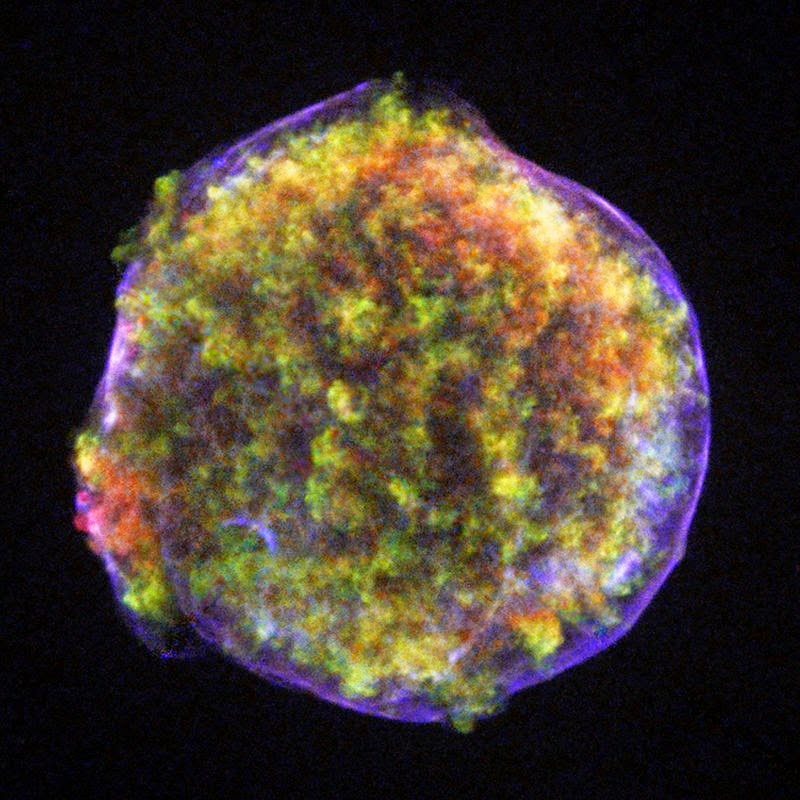
1572 AD - Tycho's Supernova

1881 illustration of Tycho's supernova
In 1572AD, Britain was rule by Queen Elizabeth 1st. On the 21st January 1571 Queen Elizabeth opened up the royal exchange, making sure to associate the crown with the prosperity of London. In 1580 Sir Francis Drake would arrive in Plymoth after circumnavigating the world, with 53 surviving crew members. It was reported that the Queen's cut of his cargo equalled in value the crown's annual expenditure for a whole year.

 With the Renaissance and its increasing circumnavigation of the globe, Europe finally turned an eye to the sky with serious curiosity and it is with the Supernova of 1572 that we get some of our strongest European sources. Europe, China and Japan all reported this remarkable phenomenon, but perhaps the most widely used source for the supernova is the Danish nobleman Tycho Brahe's book ‘De nova et nullius aevi memoria prius visa stella, iam pridem anno Ă  nato Christo 1572, mense Novembri primum conspecta, contemplatio mathematica’ (‘Concerning the New Star, never before seen in the life or memory of anyone…’).
 The new star appeared in the constellation Cassiopeia and Tycho was able to take careful measurements of the new star's position, recording it at leangth and creating accompanying drawings that survive to this day.


Tycho's Illustration of the 'New Star'

 It is thought that the appearance of this supernova, and all the recordings and discussions that it sparked, helped speed forwards the development of astonomy as we know it. The models of the heavens were revised and Aristotle's theory of the unchangeable heavens challenged, more precise astronomical devices were sought out, and the value of proper measurements was emphasised anew when creating star charts.

The supernova did not even escape Queen Elizabeth I's notice. She called her astrologer Thomas Allen and said that she would wish "to have his advice about the new Star that appeared in the Cassiopeia to which he gave his Judgement very learnedly".
SN1572
 It's not surprising that the star did not escape her notice. Reliable contemporary reports state that the 'star' flashed into creation around November 2nd/6th where it rivalled Venus in brightness. It stayed longer than the previous supernova that we've seen, remaining visible to the naked eye until 1574, where-after it gradually diminished and disappeared.

The Chandra X-Ray observatory satellite has, in modern times, managed to locate SN1572. It's an expanding bubble of plasma with temperatures in the millions of degrees and certainly had a remarkable birth.


1604 AD - Kepler's Supernova

Kepler's Drawing showing the
location of the new star at the foot(4x8)
In 1604 in Britain, King James 1st had been on the throne for a year and his first major act of foreign policy was to end the war with Spain which had been going on for some 20 years by this point, albeit intermittently. England, which had been near bankruptcy for some time at this point, was able to finally recoup its losses and peace between the two countries would continue for another 50 years.

Attached to the constellation Ophiuchus, like it's predecessor Keplar's Supernova was reported to have been brighter at it's peak than any other star in the night sky, rivalling Venus in it's magnitude. It was visible in daylight for three weeks, but was observed and tracked in the night sky for 18 months.
While named in Europe, it was also observed in China and Korea

SN1604
It is thought that the supernova occured some 20,000 light years away from Earth and it has largely been marked as the last supernova to be observed in the Milky Way, though it is debatable whether there have been other astronomical occurrences of supernovas in 1680 and 1870 that sent out signals but that generally escaped notice. It's likely that interstellar dust absorbed their light, preventing us from viewing and recording them.

 In 1885, outside the Milky Way, S Andromedae was observed and in 1987 a Andromedae-based 'Large Maellanic Cloud' was seen by the naked eye, despite its source being some 163,000 light-years away. But our Milky way seems, for now, to have fallen relatively quiet.


Could we experience supernova in our lifetime?

All of this proves just how common supernova can be, and the more advanced we become in observing the beautiful and potentially deadly universe around us, the more we can predict events like supernovae and get ready to view them in all their glory. 
The place to watch at the moment is none other than Betleguese.

No, not that one.
 
The Betleguese that Ford Prefect comes from.

Scientists have been observing Betleguese  for some time and have identified that it is remarkably unstable due to the star running out of it's core fuel. As Betleguese sits within the constellation of Orion's belt, only 640 light-years away, we are in a prime position to view the inevitable supernova in all its wonder. Despite some mild panic in 2012 when sensationalists tied Betleguese's supernova to the Mayan 'doomsday' calendar predicting the end of the world, the supernova is actually comfortably far away enough for it to cause Earth no real harm. Instead, as with our historical supernova, we would experience a bright light in the sky for a few weeks which would dim either quickly or over a year or two, before fading out completely.

So when will this happen?

While we can point out unstable stars and the inevitably of a supernova happening eventually, stars operate an wholly different time-scales to what we are used to. Betleguese will explode very soon indeed in the terms of stars, but in reality this could be anything from tomorrow to a million years from now. All we know is that it will be quite the show when it happens.


While Supernova are very dramatic, our stars are changing all the time in different ways.

IF you're curious and you have a little time to fill, the app SpaceTime tracks how our constellations have drifted and changed shape throughout history, and how they might well be next to unrecognisable in the future.


Sources


The Sun is a magnificent thing.

It is 109.2 time's larger than our humble Earth, with a radius of 695,508km and a mass of 1,989,100,000,000,000,000,000 billion kg. With a surface temperature of 5,500 degrees Celsius it is a hellish landscape, often spewing out tendrils of radioactive heat and solar winds that, at any moment, has the potential to wipe us out. Yet, paradoxically, these winds are captured and warped by the Earth's magnetic fields into the heavenly spectacle of the Northern Lights. Despite the hellscape of the sun's surface, this heat gives us light and life.  Despite the distance between this vast star and our planet, we see it as a humble bright speck that grants order and wonder to the creatures that scuttle beneath it. Like clockwork the sun counts the days and, at each night, it appears to leave us.

Even in these days of modern space travel the significance, power and beauty of the sun still continues to enchant us. So it is of no surprise that, in our cultural pasts, the sun was revered and became the subject of many a creative legend in order to explain it's presence and role in our skies. This week I wanted to share just a few of the multitude of unusual stories about our sun from history, courtesy of the brilliant book Mythology: an Illustrated of World Myth and Storytelling (Edited by C.Scott Littleton).


Grandmother Spider Steals The Sun

The Native American peoples have many creation stories about the sun and the stars, with many stories focused around the animals that lived in the great continent. For the Cherokee people in the south-east, these animals brought the sun to their lands through teamwork and clever theft.

"At first there was no light anywhere and in the darkness everyone kept bumping into one another. "What we need in the world is light!" they all agreed, and so they conveyed a meeting. The red-headed woodpecker made a suggestion: "People on the other side of the world have light, so perhaps if we go over there, they will give us some."
After much argument, Possum said: "I'll go and get light. I have a bushy tail and can hide the light in my fur." So he travelled east, screwing up his eyes against the brightness. When he arrived on the other side of the world, he found the sun, grabbed a piece of it and hid it. But the sun was so hot that it burned all the fur from his tail, and when he came home he had lost the light.
Next, Buzzard went on a quest. On reaching the sun, he dived out of the sky and snatched a piece of it in his claws. Setting it on his head, he started for home, but the sun burned off his head feathers and Buzzard also lost the light. When Buzzard returned home bald, everyone despaired.
Suddenly they heard a small voice from the grass. "You have done the best a man can do, but perhaps a woman can do better." Who is that speaking?" the animals shouted. "I am your Grandmother Spider," replied the voice. "Perhaps I was put in the world to bring you light."
The Spider rolled some clay into a bowl and started towards the sun, leaving a trail of thread behind her. When she was near the sun, she was so little that she wasn't noticed. She reached out and gently took a tiny piece of the sun. Placing it in her bowl, and following the thread that she had spun, Spider returned from the east to the west. And as she travelled the sun's rays grew a spread before her, across the whole world.
To this day, spiders webs are shaped like the sun and its rays. And spiders always spin them in the morning, to remind us of their divine ancestor."


When the Sun Lived on the Earth
The San people (previously known as the 'bushmen' of the Kalahari) have lived in Africa for some 20,000 years and stories have been passed down to the modern day through a vast oral tradition. One of the tales about the sun's first appearance in the sky gives the sun a human origin.

"In the earliest days the sun lived among the tribes of the bush. he was like other men except that a brilliant light shone from his armpits when he raised his arms; then when he let his arms fall again, darkness swept across the Earth. A wise old woman instructed her grandchildren to creep up on Old Man Sun and hurl him into the sky so that the light he released could fall far and wide on all living things. they waited until the Sun had laid down on the ground to sleep, then they crept towards him stealthily and in an instant had seized him and flung him high over their heads into the great cavern of the sky. They called out to him to stay put and to descend no more to Earth. Far away, across the bush, the children's relatives saw the Sun appear as a golden sphere in the heavens and were pleased. the darkness was driven from their skies."


The Boomerang and the Sun

One of the many stories from the aborigine people of Flinders range in Australia tell the tale of how the sun came to make it's cycle across the sky after previously an eternity of daylight. It was all down to the revenge of a Goanna lizard and a gecko.

"One day the Goanna and the Gecko set out to visit neighbours only to find, to their horror, that their friends had been massacred. With one voice they declared vengeance on the one who was responsible. It had, it soon transpired, been the sun-woman and her dingo dogs who had attacked and killed the defenceless community: she was a formidable foe and the Goanna and Gecko were quite undaunted. As the sun-woman stormed and shouted her defiance, the lizard drew his boomerang and hurled it and dashed the sun clean out of the sky. She plummeted over the western horizon, plunging the world into total darkness - and now the Goanna and the gecko really were alarmed. What would become of them without the sun-woman and her warming illuminating rays? They must do everything they could to restore her to the heavens. the Goanna took another boomerang and hurled it westwards with all of his might to where he had seen the target disappearing. It fell ineffectually to the ground so he threw two others to the south and to the north, but they too drifted back without hitting anything. In despair, the Goanna took his last boomerang and launched it into the eastern sky - the opposite direction from that where he has seen the sun-woman sinking. To his astonishment it returned, driving before it the sun's burning sphere, which tracked westwards, across the sky before disappearing. From that day on the sun maintained it's course, rising in the east and setting in the west, lighting up the day for work and hunting and casting the night into shade for sleeping. All agreed that this was an ideal arrangement, and the Aborigines of the Flinders have felt a debt of gratitude to the Goanna and the Gecko ever since."


The Sacrifices of Tecuciztecatl and Nanahuatzin

The cyclic nature of the gods and creation in mesoamerican culture was one that was tainted with bloodshed and sacrifice, and it was through the sacrifice of two noble gods that the sun and the moon came into being once again.

"The creation of the sun and moon took place at the great ceremonial centre of Teotihuacan, about twenty-five miles northeast of modern Mexico City. After the fourth holocaust, in which the sun as well as the earth had been annihilated, four gods met in the darkness at Teotihuacan to create a new sun. They agreed that the self-sacrifice of a god was required to bring it into being.
As the gods discussed who should die by fire to create this new sun, the vain and handsome Tecuciztecatl put himself forward "to carry the burden, to bring the dawn." but the gods decided to make him compete with a god Nanahuatzin for the position of sun or moon. Although an equally powerful god,
Nanahuatzin was very humble, maybe because he was disfigured by running sores.
While the gods built a vast sacrifiial bonfire,
Tecuciztecatl and Nanahuatzin did penance on two mounds. the two gods now presented offerings that reflected their personalities.Where vain, boastful Tecuciztecatl brought quetzal feathers and gold, Nanahuatzin brought bunches of reeds. Where Tecucixtecatl offered awls of coral and jade, Nanahuatzin merely offered cactus spines anointed with his own blood.
When, after four days, the sacrificial fire had become searingly hot, the two gods were robed for their ordeal. Tecuciztecatl ran towards the flames but four times recoiled in terror from the intolerable heat. So the gods called on Nanahuatzin. daring, determined, resolved and with hardened heart, he shut his eyes. he did not falter or turn back. All at once he threw himself into the fire. His body crackled and sizzled and he burned. Spurred on by Nanahuatzin's heroic act, Tecuciztecatl too ran into the pyre.
The gods now waited in the darkness for the birth of the new sun. But instead Tecuciztecatl rose as the moon, casting a blinding light. To subdue his brilliance, one of the gods threw a rabbit up into his face. This rabbit can still be seen on the face of the full moon.
Nanahuatzin now rose in the heavens as the new sun, but refused to move across the sky until he had been fed with the hearts and blood of all the other deities. Incensed at thsi demand, the Morning Star attacked the sun with his darts and spear, only to be defeated and hurled down into the underworld. The sun god was acknowledged as supreme, and all 1,600 gods now allowed themselves to be sacrificed,
The humble, ulcerated Nanahuatzin was thus transformed into the mighty sun god Tonatiuh, he "who blinded one with his light". The first day of the fifth sun has begun."


For every culture that has turned its face up to the sun, there are creative stories that tell of its history. I hope that you've found some of these more uncommon stories as interesting as I have.


Sources
-Space facts
-The sun's name
-Current Solar Images
-The San People
 -Stories taken from the brilliant book Mythology: The Illustrated Anthology of World Myth and Storytelling  -general Editor C.Scott Littleton